About the Artwork
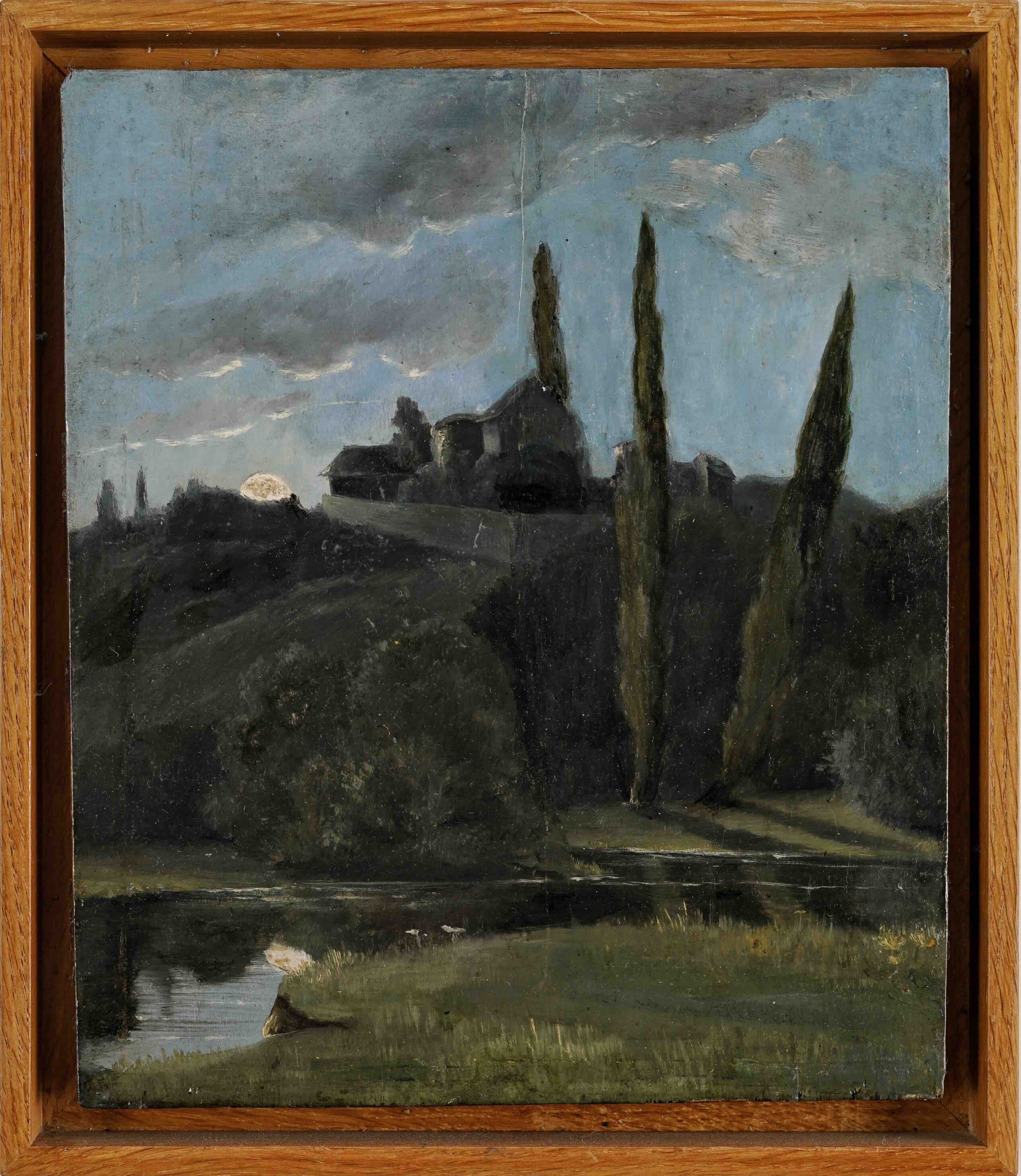
This intimate landscape, painted by an unidentified artist of the late nineteenth-century French school, captures a quiet moment at the close of day. Slender cypress trees rise against a luminous sky, their dark vertical forms punctuating the composition, while denser woodland gathers in shadow across the middle ground. A calm river occupies the foreground, reflecting the fading light and extending the atmosphere of the sky into the lower half of the painting. Much of the work’s effect depends on the handling of evening light. Long shadows stretch across the ground, trees are reduced to dark silhouettes, and the distant buildings emerge softly from the surrounding landscape. Their presence introduces a subtle balance between nature and habitation, between the irregular forms of trees and water and the more ordered geometry of architecture. Rather than presenting a dramatic view, the artist concentrates on atmosphere and the changing character of light at a particular hour. In this respect, the painting belongs to a broader tradition of late nineteenth-century French landscape painting shaped by the Barbizon school and, in particular, by the example of Jean-Baptiste-Camille Corot. Artists working within this tradition often turned to familiar, modest landscapes, seeking to capture the effects of light, weather, and season rather than grand narrative or spectacle. Although the painter remains unidentified, the work reflects this sensibility in its quiet tonal range, restrained composition, and close attention to the relationship between light and landscape.
About the Artist
Anonymous artist belonging to the French naturalist tradition of the late 19th century. The absence of a signature does not prevent this work from being placed in the wake of plein-air painting, inherited from Barbizon, and the Romantic sensitivity to light and everyday landscapes.



 CN
CN