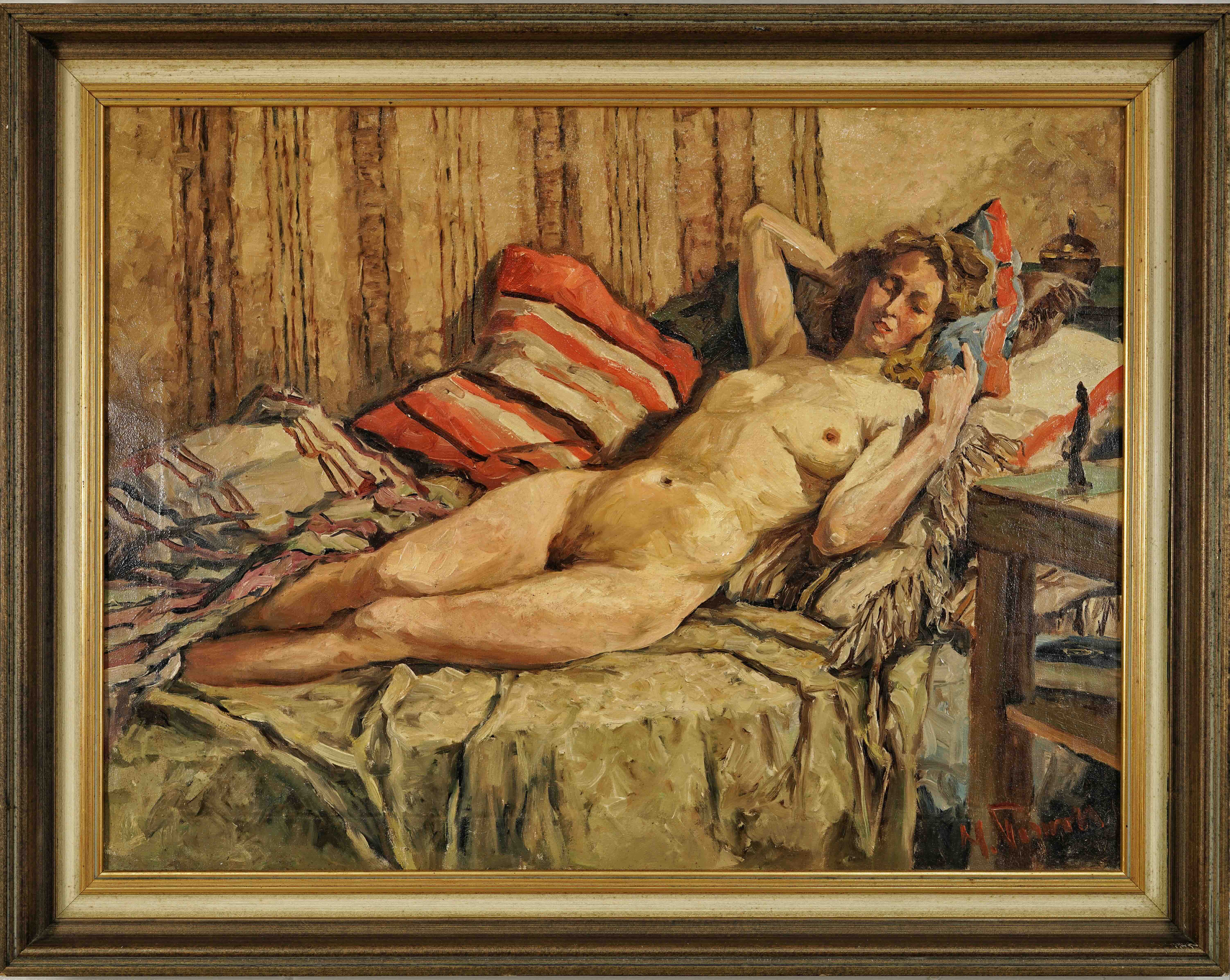
Medium: Oil on canvas
Dimensions: 60.5 x 80.5 cm
Signature: Signed lower right, partially inscribed: 'Herrn Josef Montag …'
Period of execution: Early 20th century
Price: ¥29,400
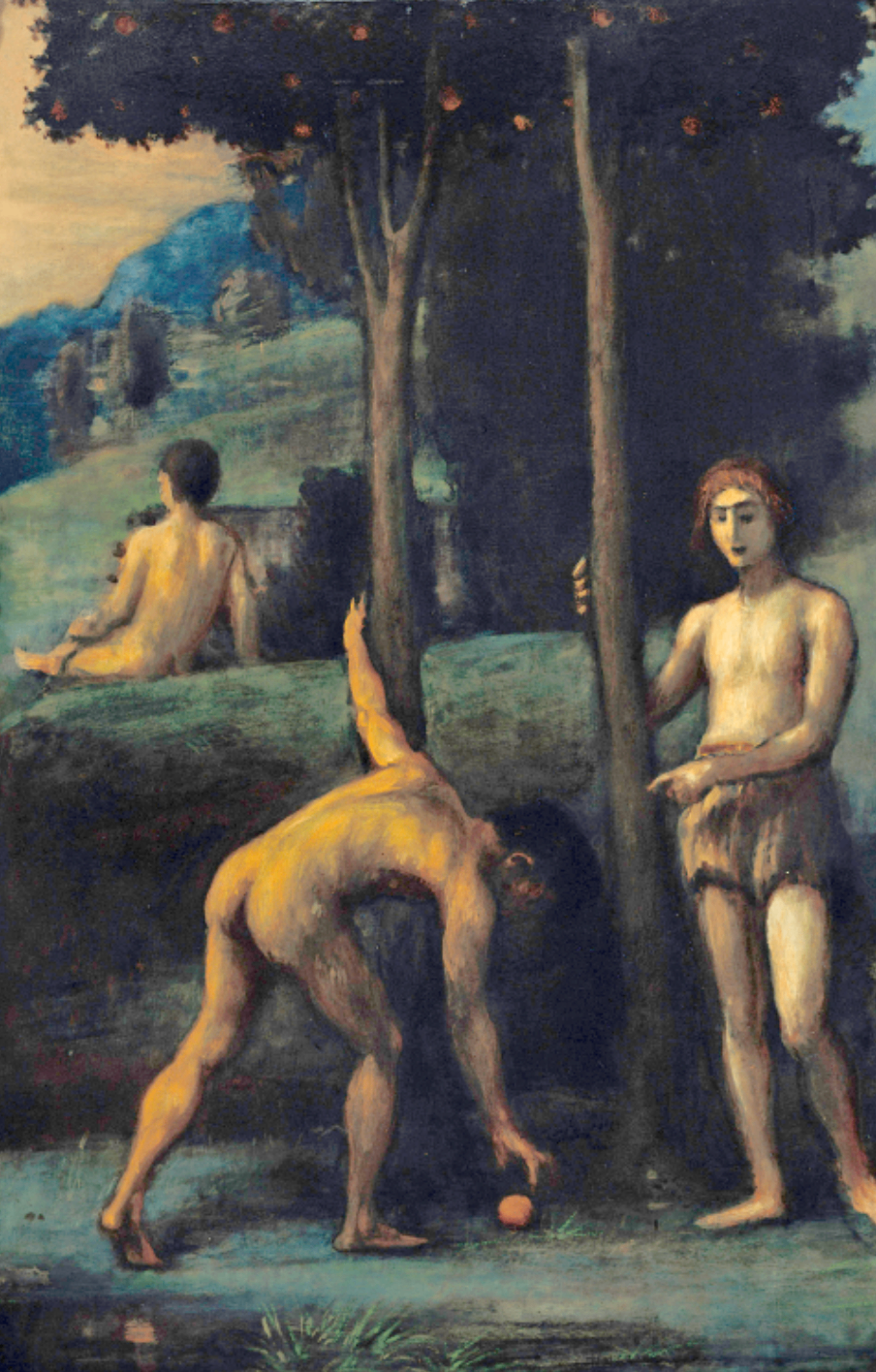
This painting depicts an intimate and tranquil scene centred on a female nude within a domestic interior. The painterly construction of the body reveals a pronounced classicist influence traceable to the German artist Hans von Marées, whose work was lauded by contemporary critics—most notably the renowned art historian of the Vienna School—as embodying "the second greatest classicism of the nineteenth century." The anatomical refinement evident in the figure pays homage to the European classical tradition, while the soft light, striped cushions, and drapery bring warmth and sensuality to the composition, echoing Renaissance ideals of corporeal beauty. The balanced chiaroscuro, coupled with restrained yet visible brushwork, tactile impasto, and nuanced tonal contrasts, establishes a direct visual affinity with Marées's particular style — most notably his Drei Jünglinge in einem Orangenhain (Young Men in an Orange Grove) in the Alte Nationalgalerie, Berlin (Fig. 1). Like Marées's treatment of musculature, the woman's flesh conveys deliberate strength and tension despite her ostensibly relaxed reclining pose. This embodied contradiction between depicted temporality and presumed comfort challenges the viewer's expectations, inviting active participation in the painting's constructed reality. The tender chiaroscuro here distinguishes itself from the extreme Caravaggesque contrasts typical of Italian tradition, favouring instead a warmer, softer rendering. The paint's textural depth results from a complex process of layering and overpainting that creates chromatic richness, distinguishing this figure from conventional nineteenth-century classicist nudes. Yet this depiction transcends mere mythological idealisation. The body becomes a site of confrontation, bringing classicism's timeless ideals into direct contact with modernity—evidenced by the distinctly contemporary studio interior typical of twentieth-century artistic practice.
The artist of this work could not be definitively identified due to an illegible signature, though it appears to read M. Tournier or N. Tournier. The painting belongs to the academic nude tradition that remained highly fashionable from the turn of the twentieth century through the 1930s and 1940s. The interior setting—with its striped red cushions, background curtains, and carefully posed model—suggests the intimate yet meticulous atmosphere typical of painters' studios during this period. The artist was likely either a Franco-German painter or a French artist whose work circulated within or was acquired by the German market. While "Tournier" is distinctly French, the presence of an old framing label from Koblenz bearing the name Josef Montag strongly suggests German provenance and circulation. The pictorial treatment and composition indicate a painter active in Central Europe during the first half of the twentieth century, probably operating within German artistic circles. The work demonstrates considerable mastery in rendering the female form and modulating light, executed in a style that merges academic precision with Impressionist realism.



 CN
CN