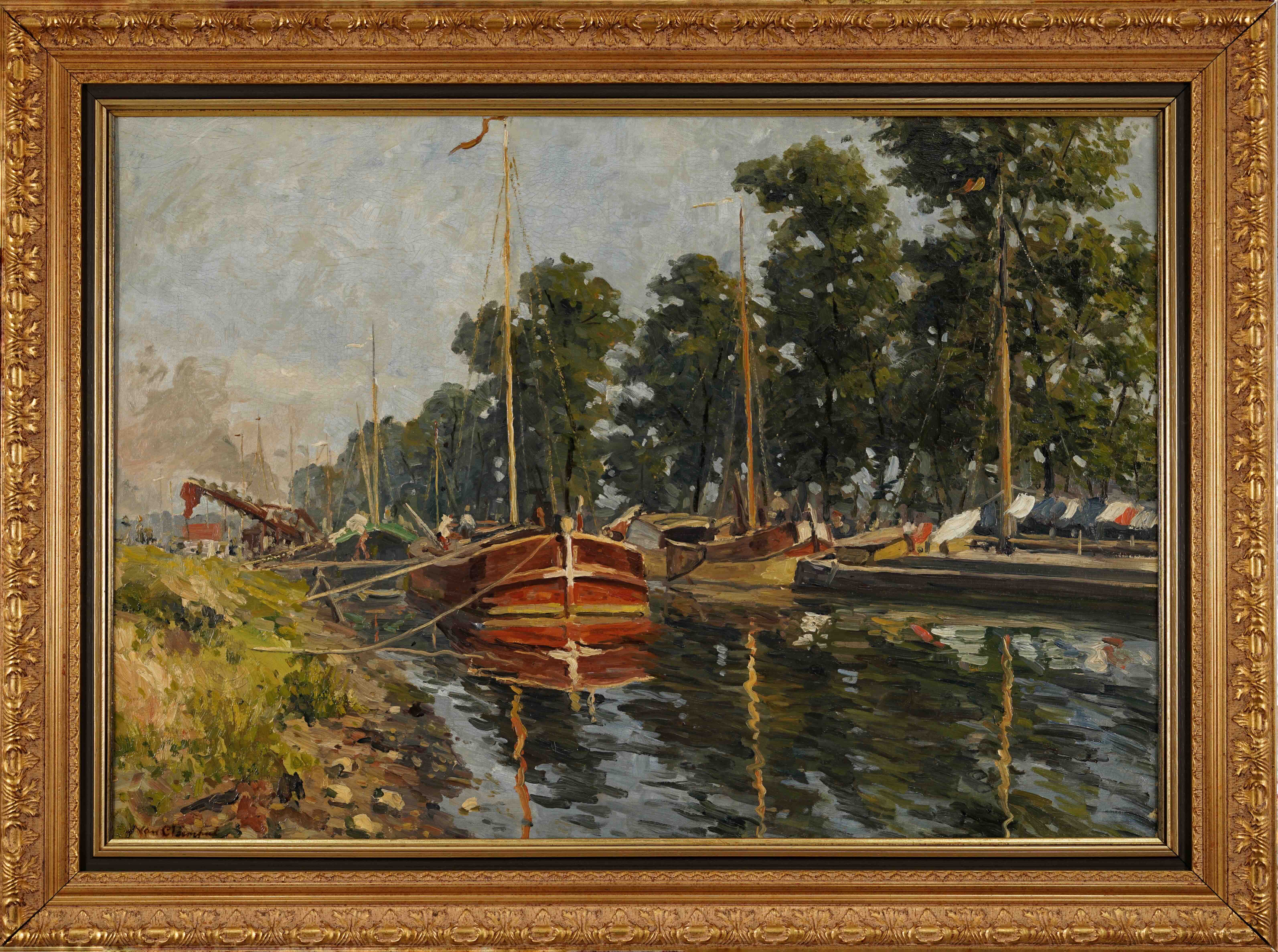
Medium: Oil on canvas
Dimensions: 81 x 57.5 cm
Signature: Signed lower left
Period of execution: c. 1881–1953
Price: ¥ 28,300
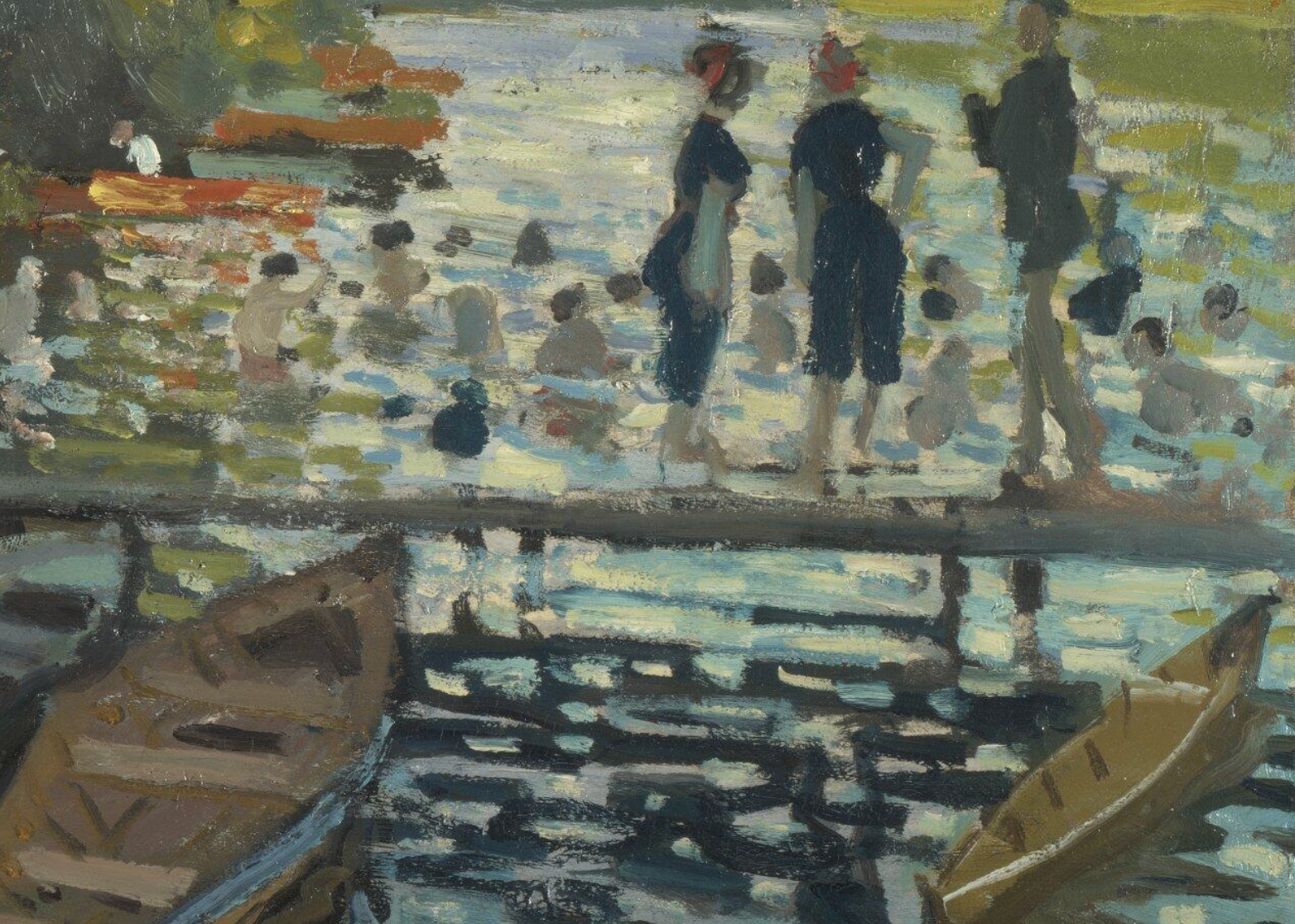
This painting depicts a canal scene with several boats gathered in the waterway, apparently waiting to pass. Beyond them, a construction site with arched structures and small figures introduces a note of activity, while a line of trees recedes into the distance. Rather than treating the scene as a straightforward record of river life, Cleemput concentrates on the changing effects of light, atmosphere, and movement. His loose handling and restricted palette recall the early work of Claude Monet, particularly the La Grenouillère (Fig. 1). Like Monet, Cleemput builds the scene through rapid, broken strokes rather than precise modelling. Boats, figures, foliage, and reflections are suggested with relatively few marks, allowing the painted surface to remain visibly active. This sense of immediacy may reflect the artist’s familiarity with Impressionist painting during his years working as a restorer at the Louvre. The composition also avoids a strongly conventional sense of recession. The line of trees cuts across the scene rather than framing it, while the boats face the viewer more directly than they follow the natural curve of the canal. The horizon is pushed towards the left, and the bridge and riverbank create broad horizontal divisions across the canvas. These choices give the composition a slightly compressed sense of space. Cleemput reinforces this effect through his treatment of paint. Forms are defined by thick, direct strokes rather than carefully blended light and shadow, while broad passages indicate figures, foliage, and reflections on the water. In some areas, particularly among the trees, the handling remains deliberately loose, with touches of pale blue appearing between the greens. These cooler accents soften the outlines and suggest the hazy, shifting atmosphere of the scene.
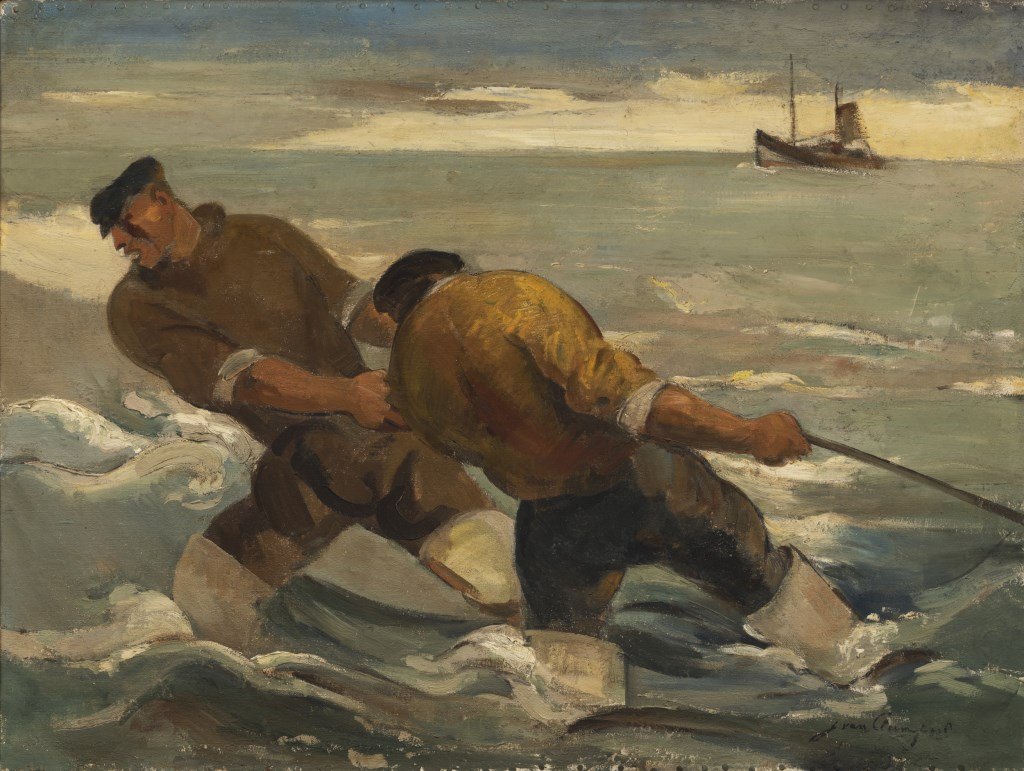
Jean Van Cleemput (1881–1953) was a Brussels-born painter, draughtsman, and graphic artist whose work developed across several of the major currents of early twentieth-century European painting. He trained at the Académie des Beaux-Arts in Brussels under Constant Montald before continuing his studies in Paris, where he also worked as a restorer at the Louvre. His early work combines careful draughtsmanship with a lighter, more Impressionist approach to colour and atmosphere, showing affinities with artists such as Frans Smeers. Over time, Van Cleemput adopted a stronger and more expressive palette, moving towards the broader colour contrasts and simplified forms associated with Fauvism. This later development also brings his work into dialogue with that of Jean Brusselmans, his brother-in-law. Across these different phases, Van Cleemput remained attentive to structure, colour, and the physical handling of paint. His career reflects a gradual movement from observational realism towards a freer and more chromatic approach. His painting The Haulers is held in the permanent collection of the Musée des Beaux-Arts de Reims (Fig. 2).



 CN
CN