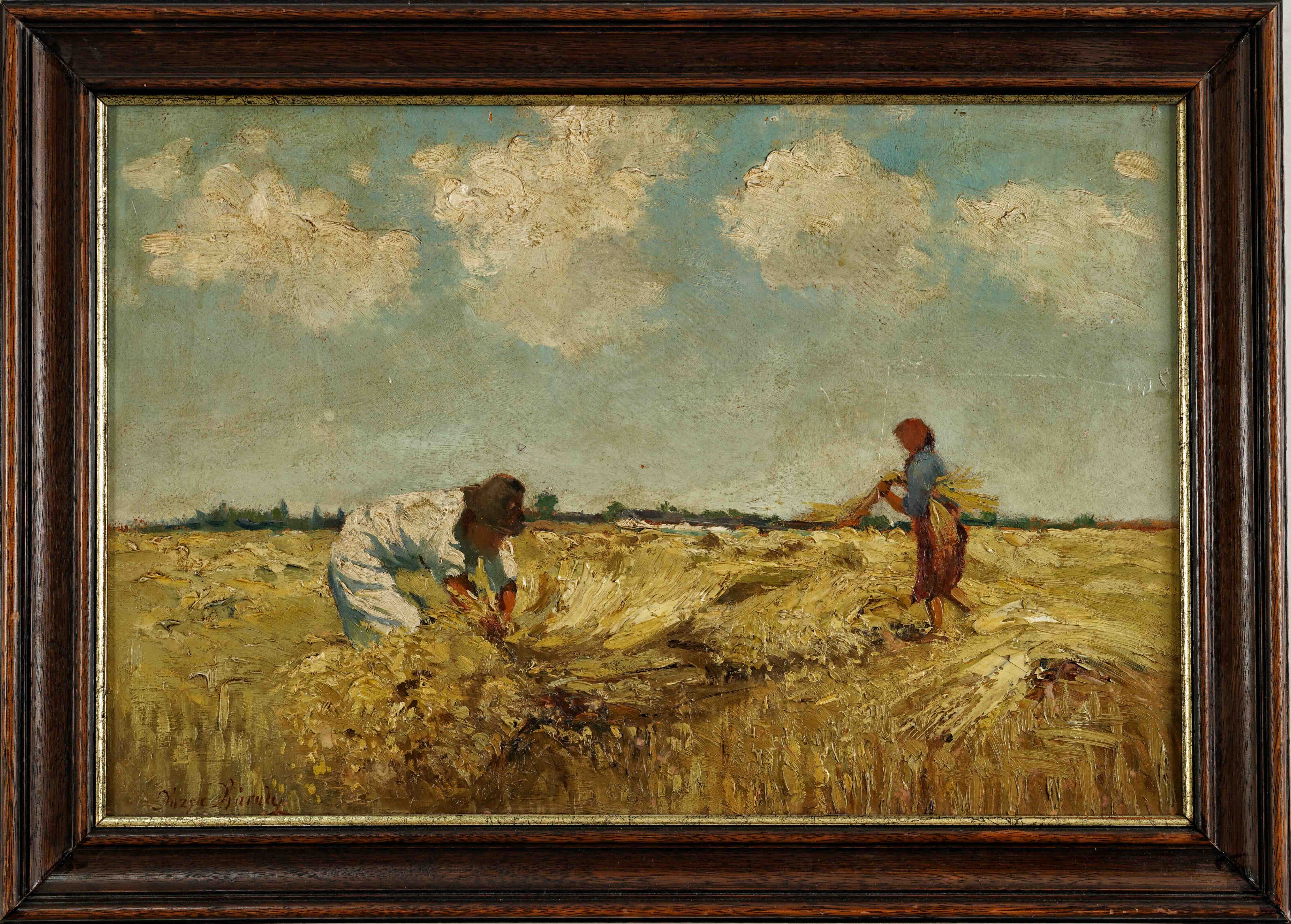
Medium: Oil on panel
Dimensions: 32 x 49 cm
Signature: Signed lower left
Period of execution: c. 1872-1929
Price: ¥ 31,700
This rural scene depicts two peasant figures working in a golden wheat field beneath a broad summer sky. One bends towards the ground in the act of cutting or gathering the crop, while the other stands upright holding a sheaf. The composition is simple and direct, organised around the contrast between the warm expanse of ripe grain and the cooler blue-grey sky above, where large clouds introduce movement and depth. Józsa integrates the figures closely with the landscape rather than isolating them as individual portraits. Their clothing, gestures, and silhouettes are absorbed into the surrounding field, reinforcing the sense that human activity and cultivated land belong to the same visual rhythm. The brushwork is vigorous and clearly visible, with thicker passages of paint giving the field and vegetation a tactile surface. The palette is relatively restrained, dominated by warm yellows and ochres in the foreground and cooler blues and greys in the sky. This contrast helps create spatial depth while also suggesting the strong light of the harvest season. The result is a scene that feels immediate and closely observed. Rather than idealising rural life, Józsa presents agricultural labour in a straightforward and sympathetic manner. The figures are shown through their work and physical presence, giving the painting a quiet sense of dignity while preserving the everyday character of Hungarian rural life.
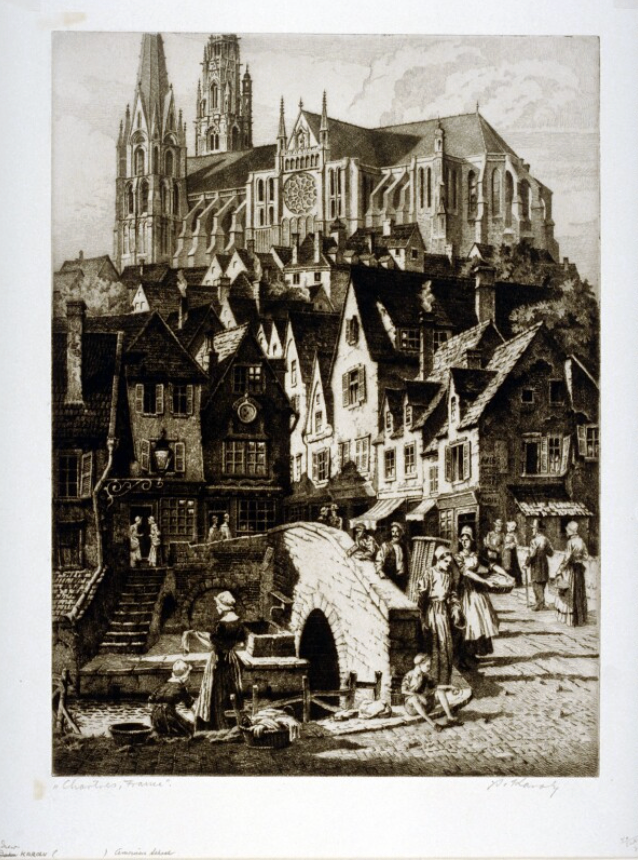
Károly Józsa (1872–1929) was a Hungarian painter, printmaker, illustrator, and designer whose career moved between fine art and commercial graphic work. He trained at the Academy of Fine Arts in Vienna under Christian Griepenkerl from 1890 to 1896, continued at Anton Ažbe’s private school in Munich between 1897 and 1900, and later studied at the Académie Humbert and Académie Julian in Paris. Józsa remained in Paris until 1908, a period during which his work expanded considerably in both subject and medium. He collaborated closely with the Austrian illustrator Raphael Kirchner on several hundred Art Nouveau picture postcards, many featuring elegantly stylised female figures with Orientalist influences. These designs formed an important part of the period’s flourishing culture of commercial illustration and decorative print. Alongside this work, Józsa increasingly developed his practice as a printmaker. By 1906, he was exhibiting wood engravings at the Salon d’Automne, including works inspired by Indigenous peoples of the American Plains. In the same year, he also contributed to the satirical magazine L’Assiette au Beurre, in what became his final collaboration with Kirchner. In 1908, before returning to Central Europe, Józsa received a gold medal from The Studio magazine in London for poster design. During these years he exhibited at the Munich Glaspalast, the Hagenbund in Vienna, and the Paris Salon. After the outbreak of the First World War, he established a permanent studio in Budapest in 1915 and increasingly returned to Hungarian subjects, particularly rural life, peasant figures, and the surrounding countryside. Józsa’s varied career reflects the international character of Central European art around 1900, moving between academic training, Art Nouveau design, printmaking, and rural genre painting. His works are represented in collections including the Clark Art Institute and the Fine Arts Museums of San Francisco (Fig. 1).



 CN
CN