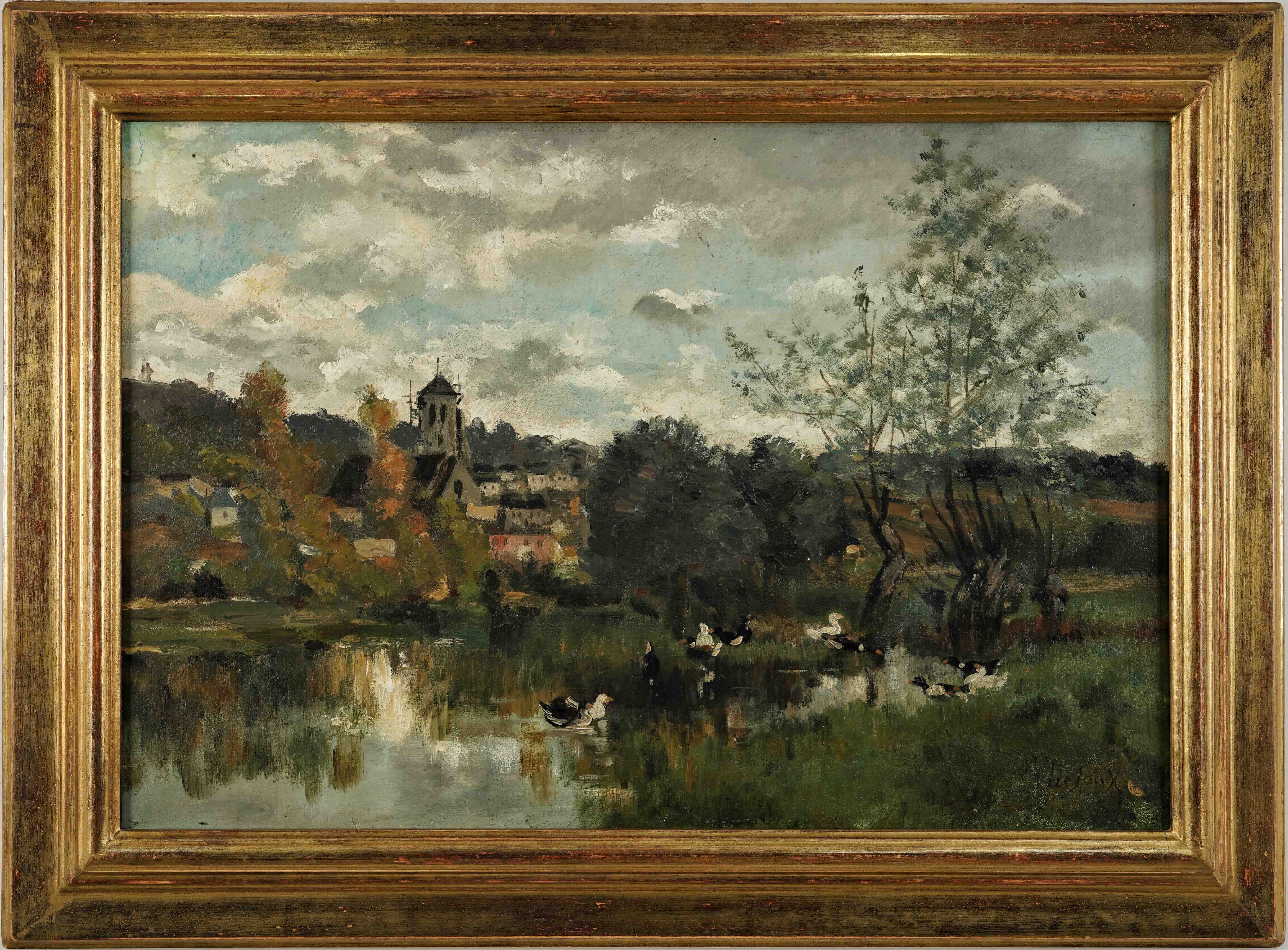
Medium: Oil on canvas
Dimensions: 54 × 73 cm
Signature: Signed lower right
Period of execution: c. 1826-1900
Price: ¥36,200
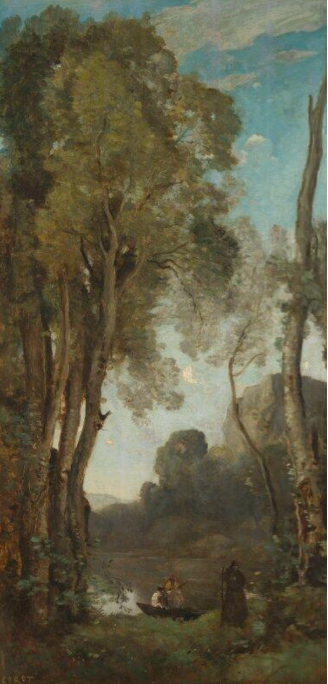
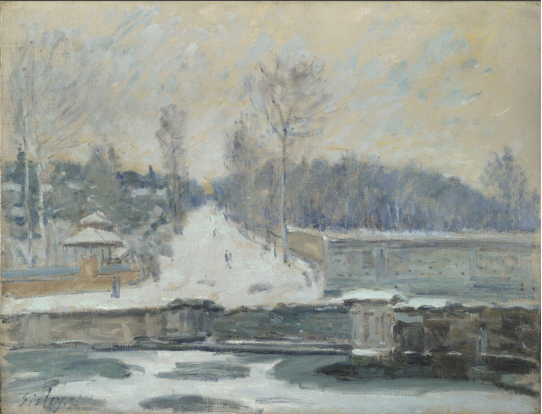
This naturalistic view of Moret-sur-Loing presents a quiet balance between rural life, river landscape, and the architecture of the town beyond. Located in the Seine-et-Marne department of the Île-de-France region, Moret-sur-Loing became an important subject for nineteenth-century landscape painters, particularly those drawn to the changing effects of light along the river. Defaux’s handling shows the influence of his mentor, Jean-Baptiste-Camille Corot. A useful comparison can be made with Corot’s The Four Times of the Day: Evening in the National Gallery, London (Fig. 1). Defaux works with a similarly restrained palette: the sky combines white and cobalt blue with touches of green, while the foliage is built from ochres, earthy greens, blues, and muted yellows. Yet his treatment of vegetation is somewhat denser and warmer than Corot’s. Rather than building the trees from soft layers of green over a pale ground, Defaux often begins with brown and introduces subdued greens and darker blues directly into the foliage. The painting also reflects the changing language of French landscape painting later in the nineteenth century. This is particularly relevant at Moret-sur-Loing, a place closely associated with Alfred Sisley, who repeatedly painted the town and its surrounding countryside (Fig. 2). Defaux’s cooler greys, blue-green tones, and attention to reflected light suggest an awareness of the Impressionist palette, even as his composition remains more firmly structured. The working process is visible across the surface. The trunk and main branches of the tree at the right appear to have been established first, before the strong blue of the sky was worked around and between them. More fluid brown strokes were then used to extend the branches, while thin olive tones describe the vegetation in the foreground. In several areas, the blue of the sky overlaps the edges of the foliage, contributing to the painting’s loose and immediate character. Thicker impasto is reserved for a few details, including the small white cloud at the centre, the ducklings in the foreground, and the reflections of clouds across the water. These touches bring light and movement to an otherwise calm and carefully balanced view.
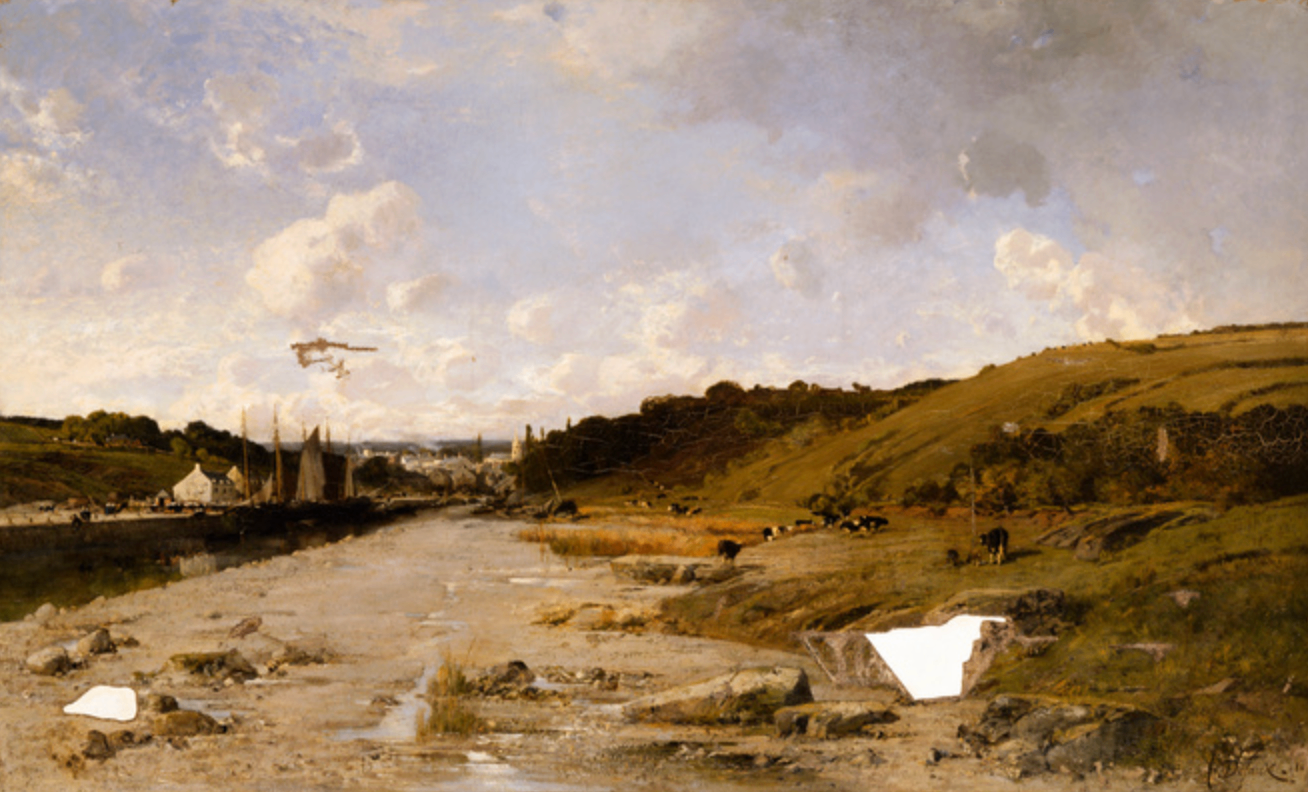
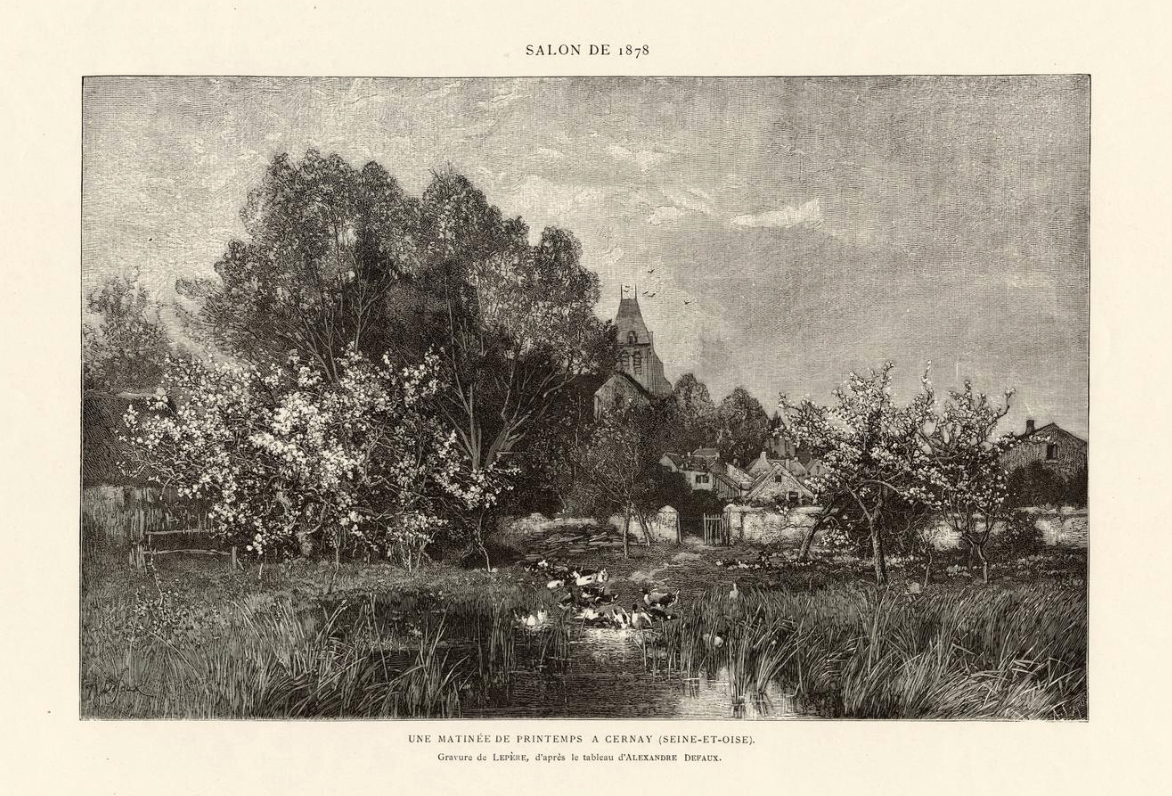
Alexandre Defaux (1826–1900) was a student of Jean-Baptiste-Camille Corot and a representative figure of the Barbizon School. He specialized in depicting the rural landscapes of Seine-et-Marne, agricultural scenes, and riverbanks. His realistic yet poetic style earned appreciation for its fidelity to the motif and gentle atmospheric qualities. Though he achieved modest success during his lifetime, two of his paintings — both titled Le Port de Pont-Aven — entered the collection of the Musée du Luxembourg in Paris in 1881 and were later transferred to the Musée d'Orsay (Fig. 3). Additionally, two etched reproductions of Defaux's work by Auguste Lepère are held in the British Museum (Fig. 4). The Barbizon School refers to a group of painters active roughly from 1830 through 1870 who advanced Realism in art within the context of the dominant Romantic movement. The "school" took its name from the village of Barbizon, France, on the edge of the Forest of Fontainebleau, where many of the artists congregated. Prominent features of this movement include tonal subtlety, sombre colour, loose brushwork, and softness of form. Jean-Baptiste-Camille Corot was among the earliest to work in the forest, first painting there in 1829, though British art historian Harold Osborne noted that "his work has a poetic and literary quality which sets him somewhat apart" from the broader movement. Nevertheless, Corot and the Barbizon painters played an important role in preparing the ground for Impressionism. Their commitment to working directly from nature and observing changing light and atmospheric conditions anticipated the en plein air practice that would later become central to Impressionist painting. In this sense, the Impressionists developed an approach that had already been explored by the previous generation, extending it through a brighter palette and a more immediate treatment of light.



 CN
CN