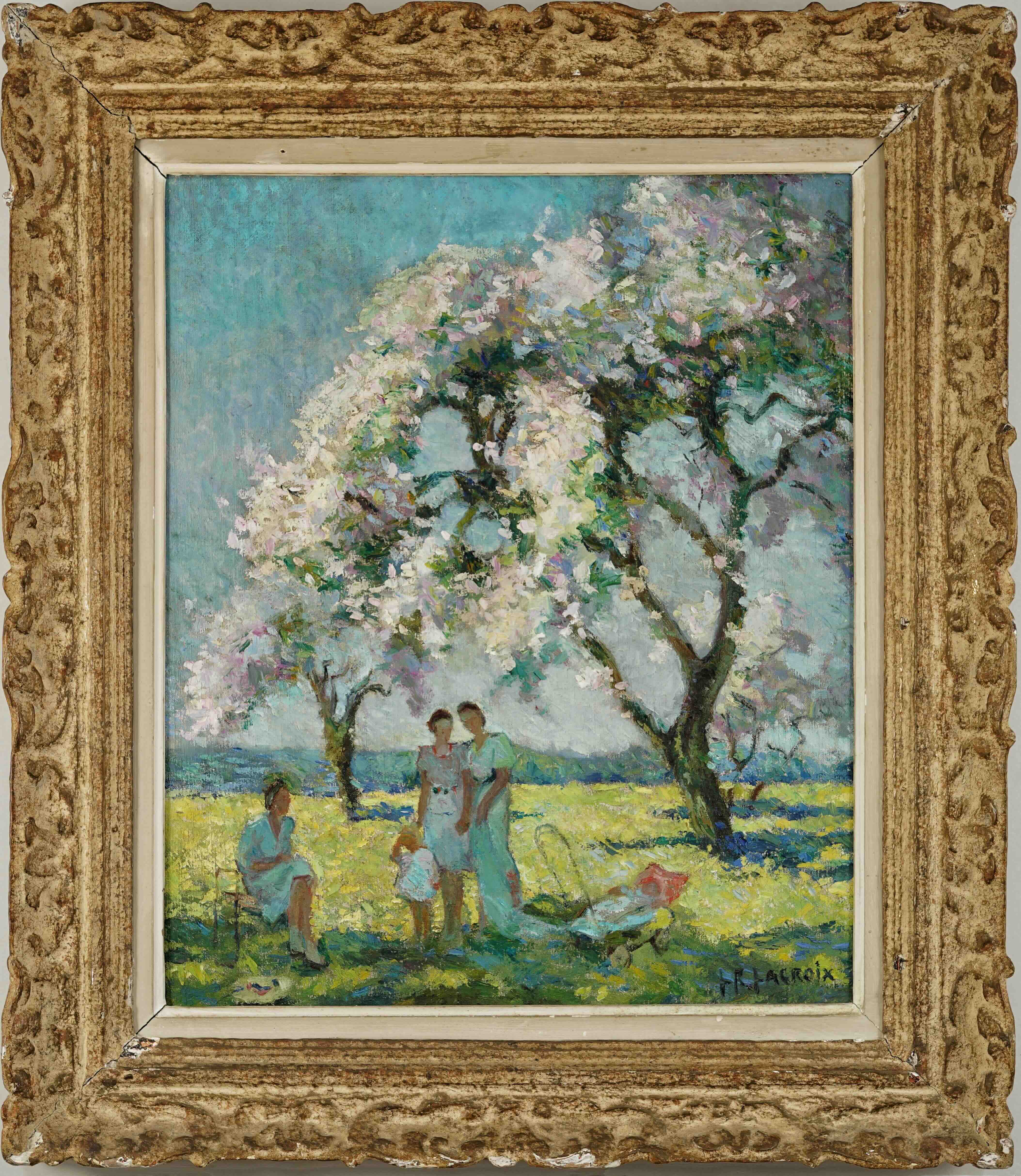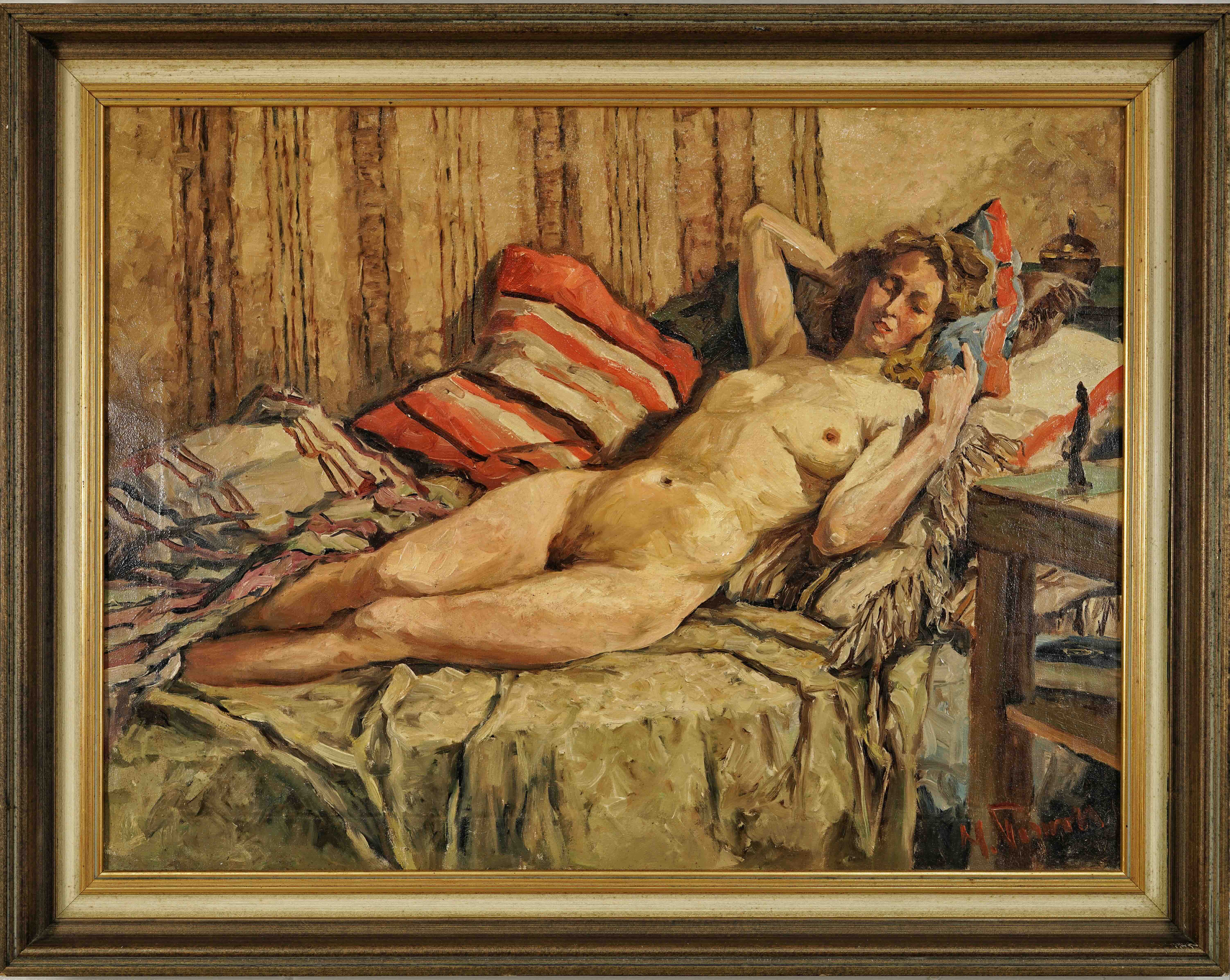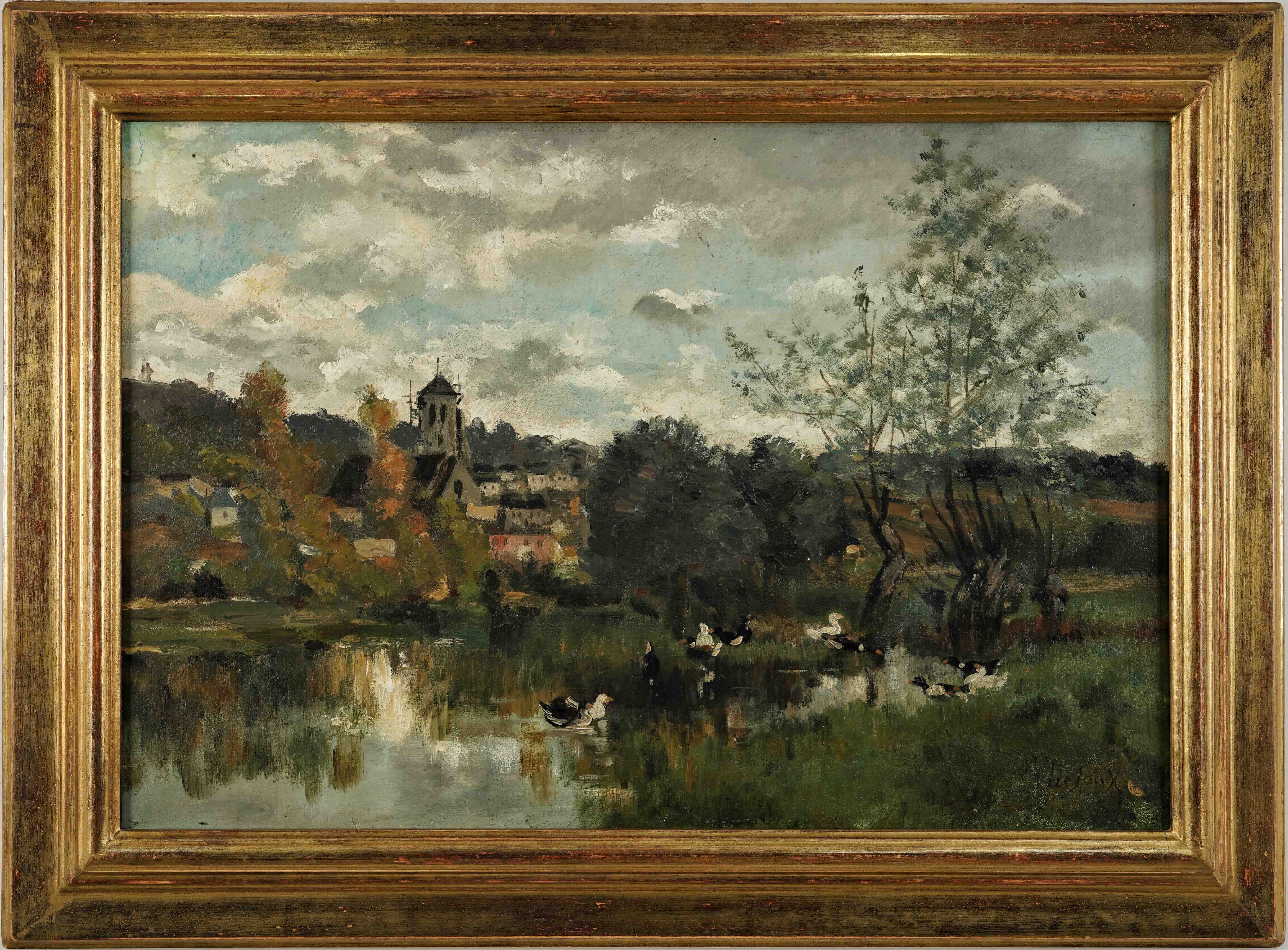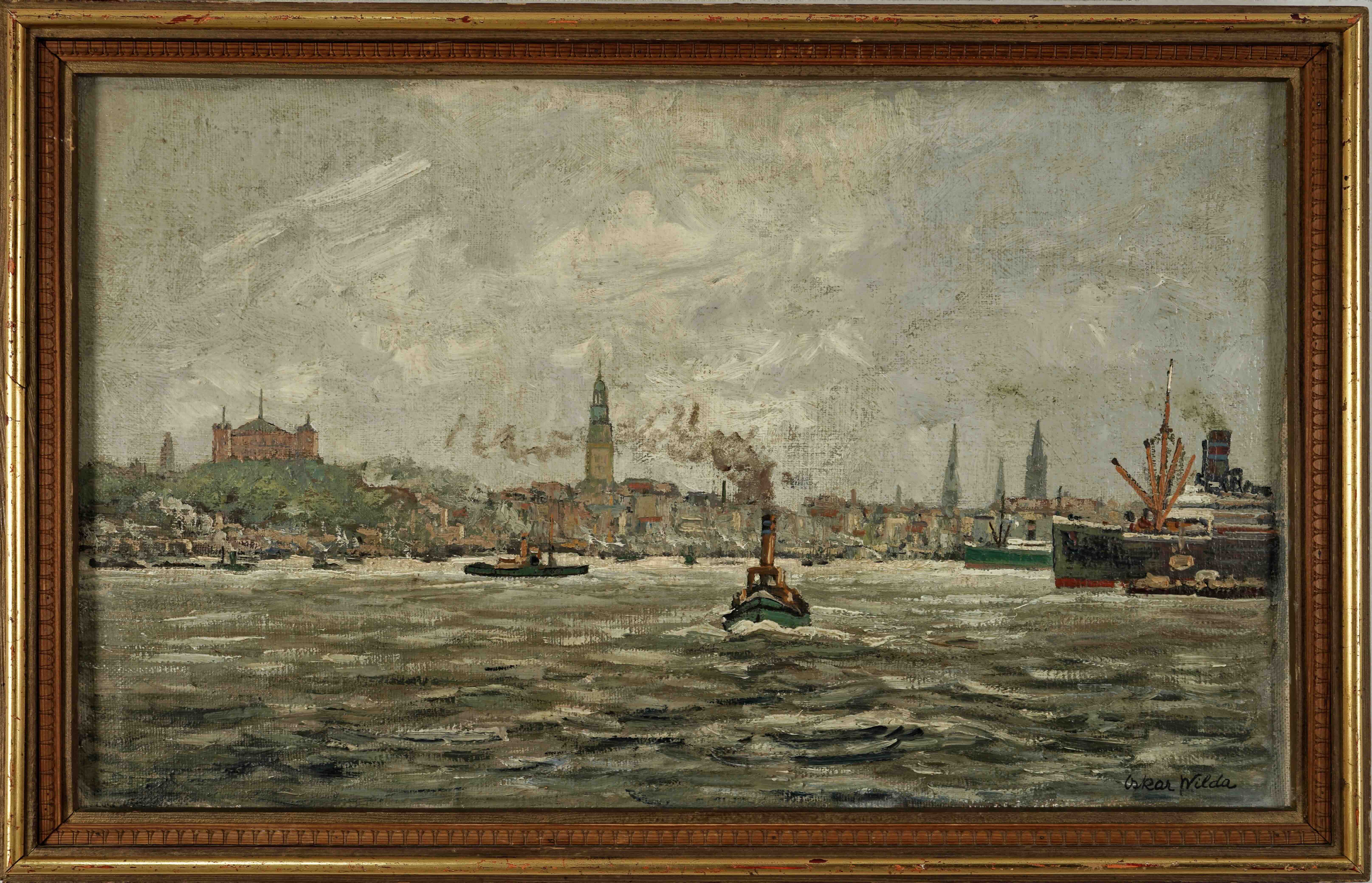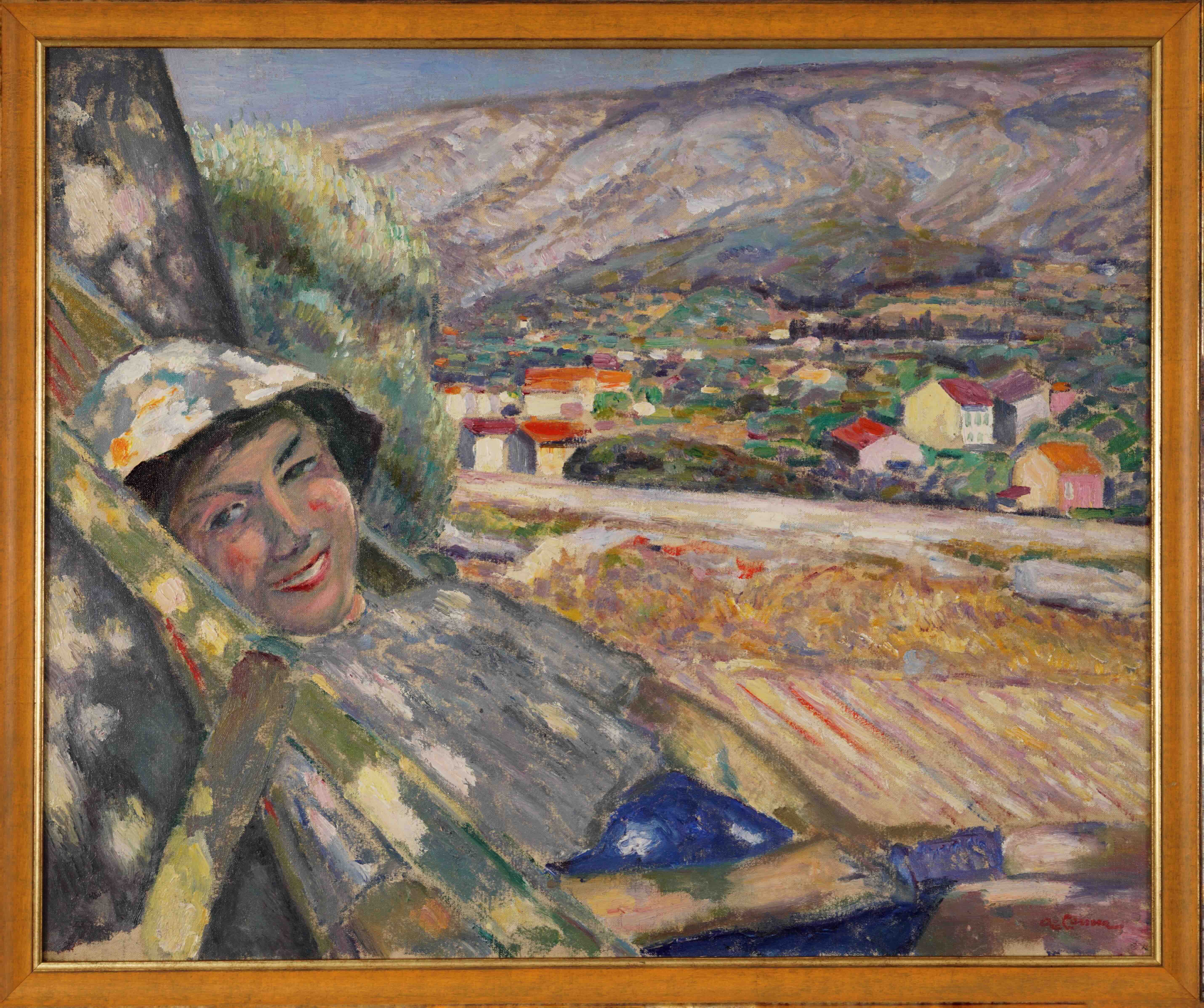
Medium: Oil on canvas
Dimensions: 54 x 65 cm
Signature: Signed lower right
Period of execution: c. 1878-1952
Price: ¥32,700
This work depicts a woman reclining in a lounge chair beneath a tree, set within a sunlit landscape characteristic of southern France. Carrera’s lively, directional brushwork reflects his debt to Impressionism, particularly to Édouard Manet’s handling of paint. In Manet’s Woman with a Cat (National Gallery, London) (Fig. 1), strokes of blue and white are laid diagonally across the sitter’s bodice, allowing the construction of the image to remain clearly visible. Carrera adopts a similar approach, using slashed, directional strokes across the woman’s chest and arms, as well as through the ploughed fields and distant townscape. His paint, however, is often denser and more tactile, combining broken brushwork with passages of wetter, more fluid colour. The cool, greyed undertones that run through the composition also recall Impressionist experiments with outdoor light. Rather than modelling the figure through strong contrasts of light and dark, Carrera builds form through shifts between complementary colours. This is particularly evident in the woman’s face. The shaded side is composed not simply of grey or brown, but of touches of orange, violet, blue, and turquoise green. These colours describe both the changing effects of sunlight and the figure’s presence within the surrounding landscape. Instead of separating the sitter sharply from her setting, Carrera allows the same colours and brushwork to move between body, vegetation, and distant ground, giving the composition a strong sense of visual unity.
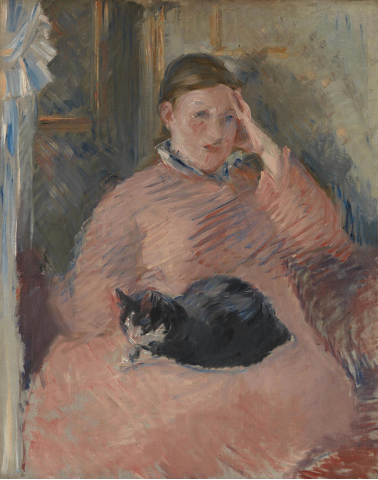
(Fig. 1) Édouard Manet, Woman with a Cat, 1880–82, oil on canvas, © Tate, London.
Augustin Carrera (1878–1952) was a French painter distinguished by his post-Impressionist and Fauvist-influenced works, particularly his vibrant depictions of Provençal landscapes and the Port of Marseille. He trained at the École des Beaux-Arts in Marseille before continuing his studies at the École des Beaux-Arts in Paris under Léon Bonnat and Henri Martin. His early work displayed the bold chromatic intensity characteristic of Fauvism and the structural influence of Cézanne. Following the First World War, his style evolved toward an Art Deco aesthetic marked by a sumptuous palette and decorative sensibility. Carrera exhibited regularly at the Salon des Artistes Français in Paris, where he received a travel grant in 1907 and was awarded medals in 1933 and 1937. His public commissions included decorative panels for the Ministry of Colonies and ceiling paintings for the Marseille Opera. In 1934, he was appointed curator of the Musée Cantini in Marseille, which, along with the Musée des Augustins in Toulouse, holds several of his works in its permanent collection. In recognition of his artistic contributions, Carrera was made a Knight of the Legion of Honour in 1920 and promoted to Officer in 1928.



 CN
CN