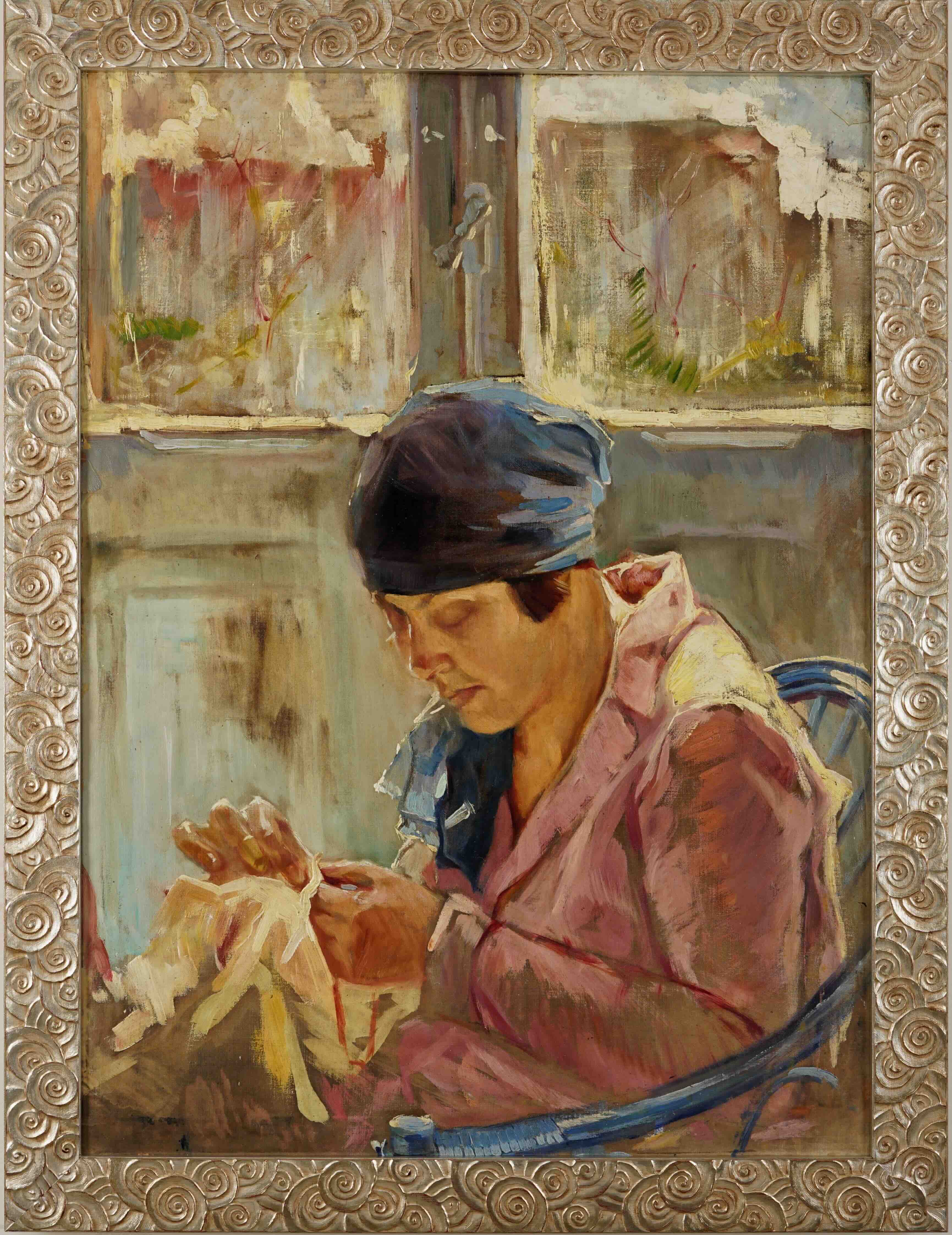
Medium: Oil on canvas
Dimensions: 73 x 57 cm
Signature: Unsigned
Period of execution: Early 20th century
Price: ¥ 28,400
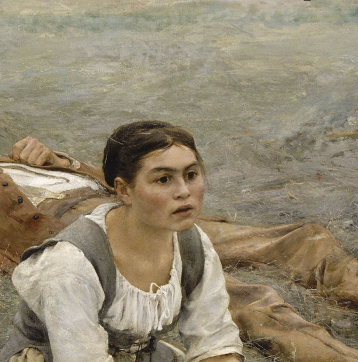
This interior scene depicts a woman sewing beside a window, rendered in a cool, luminous palette of pale pinks and blues. The delicate colour range recalls aspects of seventeenth-century Italian painting, particularly the lighter palette associated with Guido Reni’s later work. In paintings such as The Rape of Europa in the National Gallery, London (Fig. 1), Reni combined soft rose tones with pale blues and cooler highlights, creating the refined luminosity often associated with his ultima maniera. A similar relationship between pink, blue, and occasional mint-green tones appears here, suggesting an awareness of classical colour harmonies. The woman is painted in broad areas of pale, opaque colour, with particular attention to the elegance of her pose and the lighter textures of her headscarf and pink jacket. Yet the handling is distinctly modern. The brushwork remains visible, and modelling is softened rather than carefully blended, allowing the physical texture of the paint to become part of the image. The composition also reflects the influence of late nineteenth- and early twentieth-century naturalism. The space is deliberately compressed, with the window filling much of the background and functioning almost as a decorative field of blue and cherry pink. This close framing recalls the work of Jules Bastien-Lepage, particularly Haymaking (Fig. 2), where figures are brought close to the picture plane and integrated tightly with their surroundings. The treatment of the woman’s skin offers a further point of comparison. Pale highlights and warmer blush tones are blended only loosely, producing a slightly translucent effect while preserving the immediacy of the brushwork. Through its compressed perspective, light palette, and close framing, the painting combines a naturalistic subject with a more modern treatment of colour and surface.
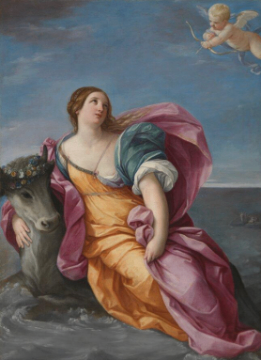
(Fig. 1) Guido Reni, The Rape of Europa, date unknown, oil on canvas, © The National Gallery, London



 CN
CN