About the Artwork
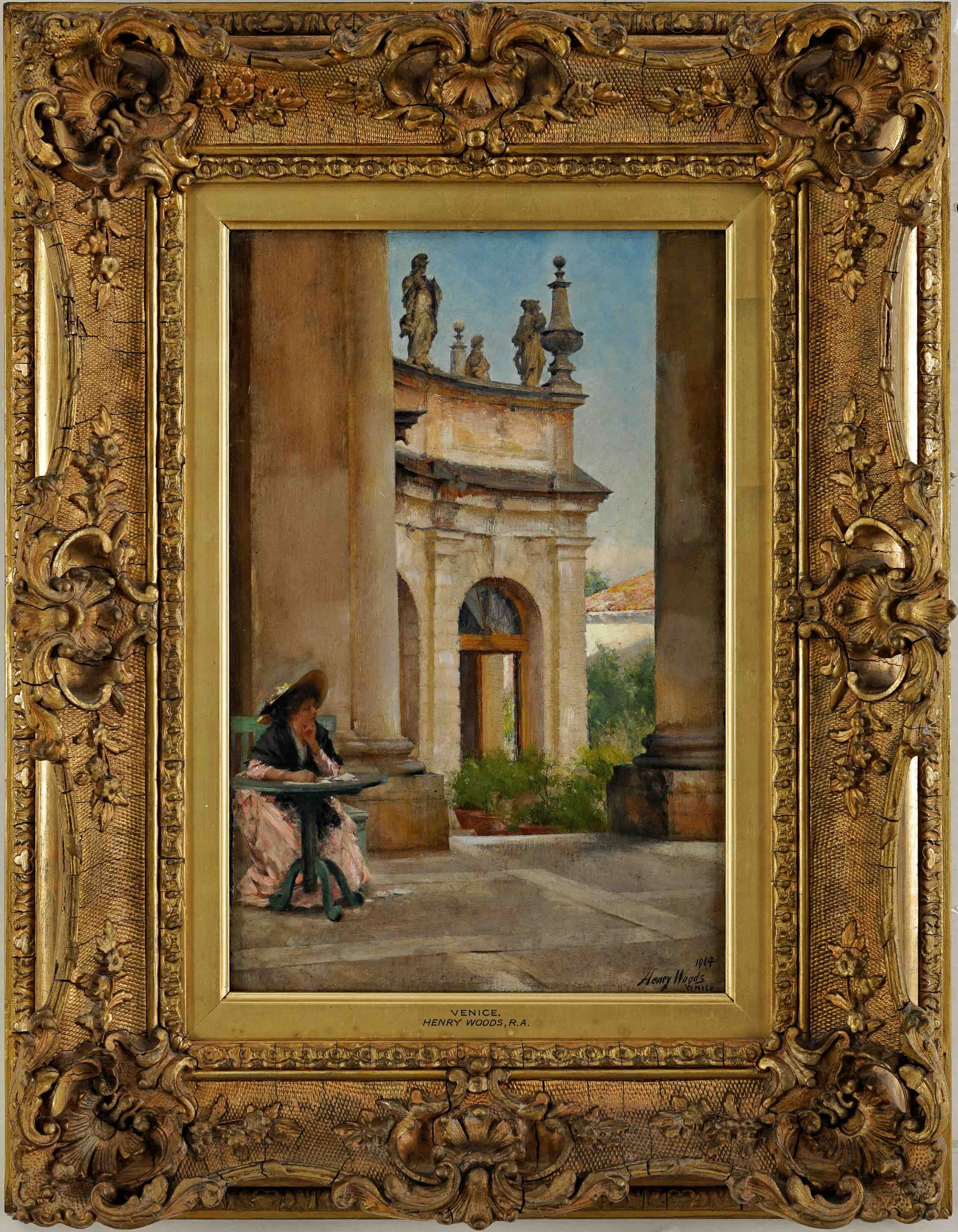
This work demonstrates Henry Woods’s sensitivity to Venetian light and architecture. A woman in a broad-brimmed hat sits in the shade of a portico, absorbed in reading or quiet contemplation. Beyond her, an elaborate Baroque gateway crowned with classical sculpture rises into a clear blue sky, its pale façade illuminated by strong sunlight. Much of the composition depends on the contrast between the shaded foreground and the brightly lit architecture beyond. The woman occupies the cooler shelter of the colonnade, while the buildings behind her are flooded with warm Mediterranean light. This contrast creates a convincing sense of depth while also setting the intimacy of the seated figure against the scale and richness of the surrounding architecture. Woods works with a warm palette of ochres, sandy beiges, and pale pinks, balanced by softer greens and touches of foliage. His handling shifts between relatively precise architectural detail and looser passages of paint used to describe light, fabric, and vegetation. This combination allows the setting to remain clearly recognisable while preserving the freshness of direct observation. Painted shortly before the First World War, the work belongs to Woods’s sustained engagement with the everyday life and architecture of Venice. Rather than presenting the city solely through its famous monuments, he brings attention to a quieter moment within the urban landscape. The seated woman introduces a sense of leisure and intimacy, while the surrounding architecture and sunlight give the scene its distinctly Venetian character.
About the Artist
Henry Woods (1846–1921) was a British painter who became a prominent member of the Anglo-Venetian artistic colony, settling permanently in Italy from the 1870s onwards. His career bridged Victorian narrative painting and the atmospheric concerns of Impressionism, resulting in a distinctive body of work that depicted Venetian daily life with naturalistic sensitivity and picturesque charm. Woods began his training at Warrington School, where he earned a Department of Science and Art bronze medal and a scholarship to the South Kensington School of Art. Moving to London in 1865 with fellow student Luke Fildes, the two forged a lifelong friendship and mutual artistic influence that shaped both their careers. In 1869, Woods and Fildes became illustrators for The Graphic newspaper, bringing them into contact with leading artists including John Everett Millais, Hubert von Herkomer, and Frank Holl. That same year, Woods began exhibiting at the Royal Academy, where he would continue to show work until his death. Settling in Venice, Woods specialised in genre scenes depicting the city's markets, canals, and domestic interiors, often featuring local figures in traditional costume. His style was influenced by Carl van Haanen and Eugene de Blaas, combining realism rendered execution with a more vibrant, impressionist-inspired palette. Woods achieved significant recognition, becoming a Royal Academician in 1893 and exhibiting regularly with the Royal Watercolour Society. His works are now held in public collections, including Tate Britain and various British regional museums, a testament to his enduring contribution to Victorian painting and the Anglo-Venetian artistic tradition.



 CN
CN