Medium: Oil on canvas
Dimensions: 46 x 55 cm
Signature: Signed lower right
Period of execution: c. 1886-1968
Price: ¥23,200
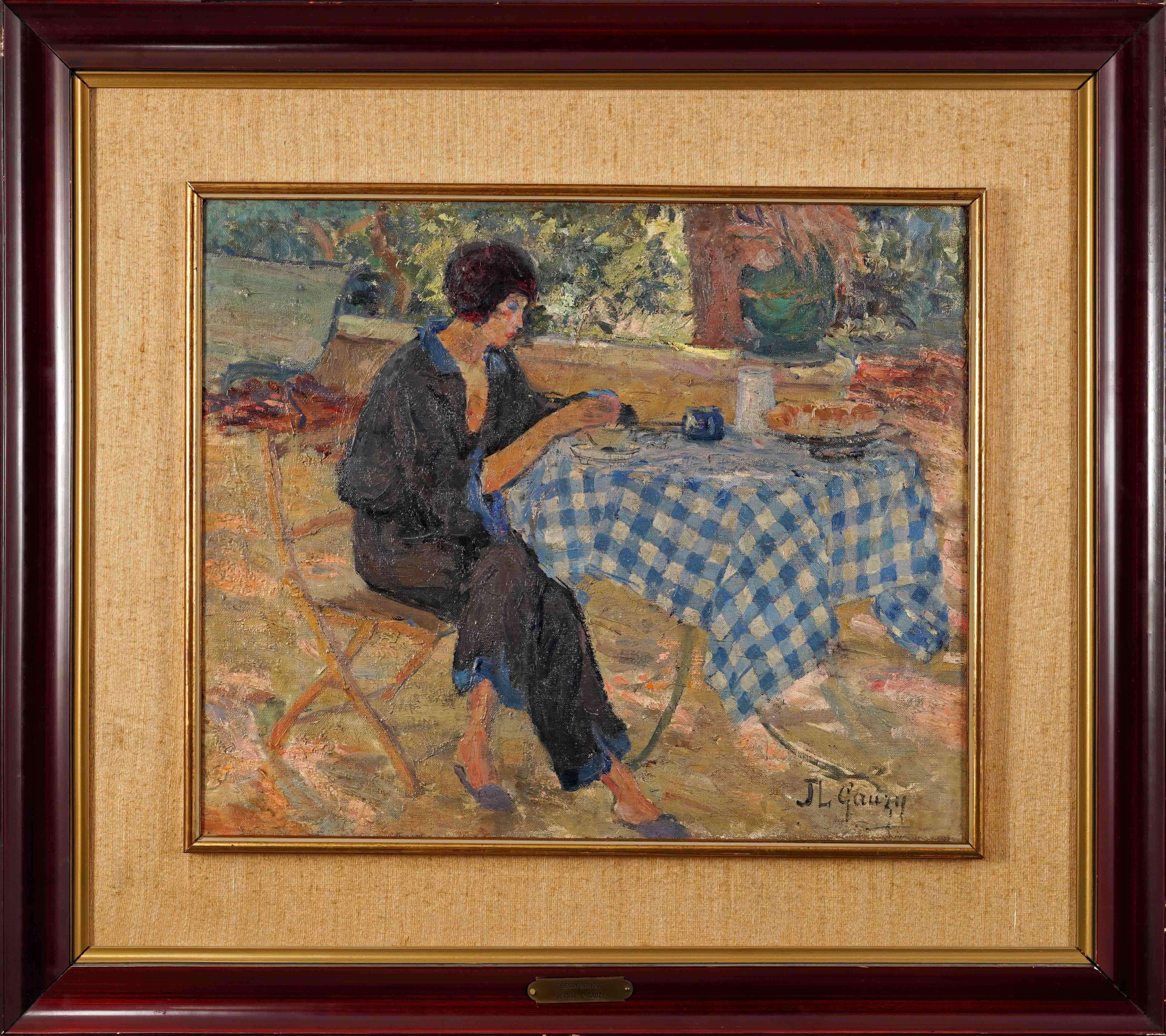
Gauzy’s painting depicts a woman in a dark navy jumpsuit seated at a table covered with a blue-and-white checked cloth, taking coffee and breakfast on a balcony overlooking dense vegetation. Above her, the tree canopy is built up with vigorous, scratched brushstrokes that suggest the rough movement and texture of leaves.
The work is characteristic of Gauzy’s pale beige tonality and sensitive treatment of light. Although the palette is largely composed of ochres and subdued colours, and the sun itself is never directly represented, the entire scene is filled with a quiet luminosity. The impression is of strong sunlight filtering through the surrounding foliage and warming the space beyond the balcony. Small passages of blue in the tablecloth, the woman’s collar, and her trousers introduce a gentle visual rhythm and contribute to the scene’s informal, intimate character. Much of this effect depends on Gauzy’s handling of colour. The balcony floor is painted in shifting patches of rosy beige, cool green, and pale olive, while the background moves towards lighter and more vivid greens. These colours create a sense of recession without relying on conventional modelling or strong contrasts of light and shade. Instead, the relatively pale background sits almost on the same pictorial plane as the foreground, giving the composition a subtly flattened quality. Gauzy also reverses the more traditional use of chiaroscuro by placing the woman’s dark figure against a considerably lighter setting. The result is a painting that combines observational realism with a freer treatment of colour and space. Its luminosity recalls the en plein air tradition, while the compressed perspective, simplified tonal structure, and confident brushwork suggest an awareness of Impressionist and Fauvist painting. Gauzy brings these elements together in a style that remains recognisably her own.
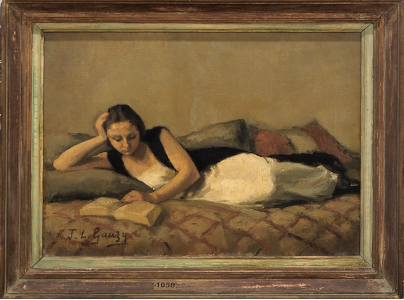
Jeanne Rachel Lévy was born in Paris on 4 January 1886. She married Fernand Joseph Raphaël Gauzy in 1910, subsequently adopting his surname professionally. An active artist throughout her career, Gauzy worked primarily in France and exhibited regularly at prominent galleries and Salons. Her achievements include a silver medal in 1922 and the prestigious Pillini Prize in 1934. In 1924, she presented four canvases at the Galerie Grégoire, comprising a floral study, a landscape, and two outdoor scenes. Her work attracted institutional recognition: four paintings were acquired by the Centre national des arts plastiques (National Centre for Visual Arts). Most notably, Black and White entered the collection of the Musée Granet in Aix-en-Provence and has remained on long-term deposit at the CNAP since 1935 (Fig. 1). Gauzy continued her artistic practice until her death in Montpellier on 30 September 1968.



 CN
CN