About the Artwork
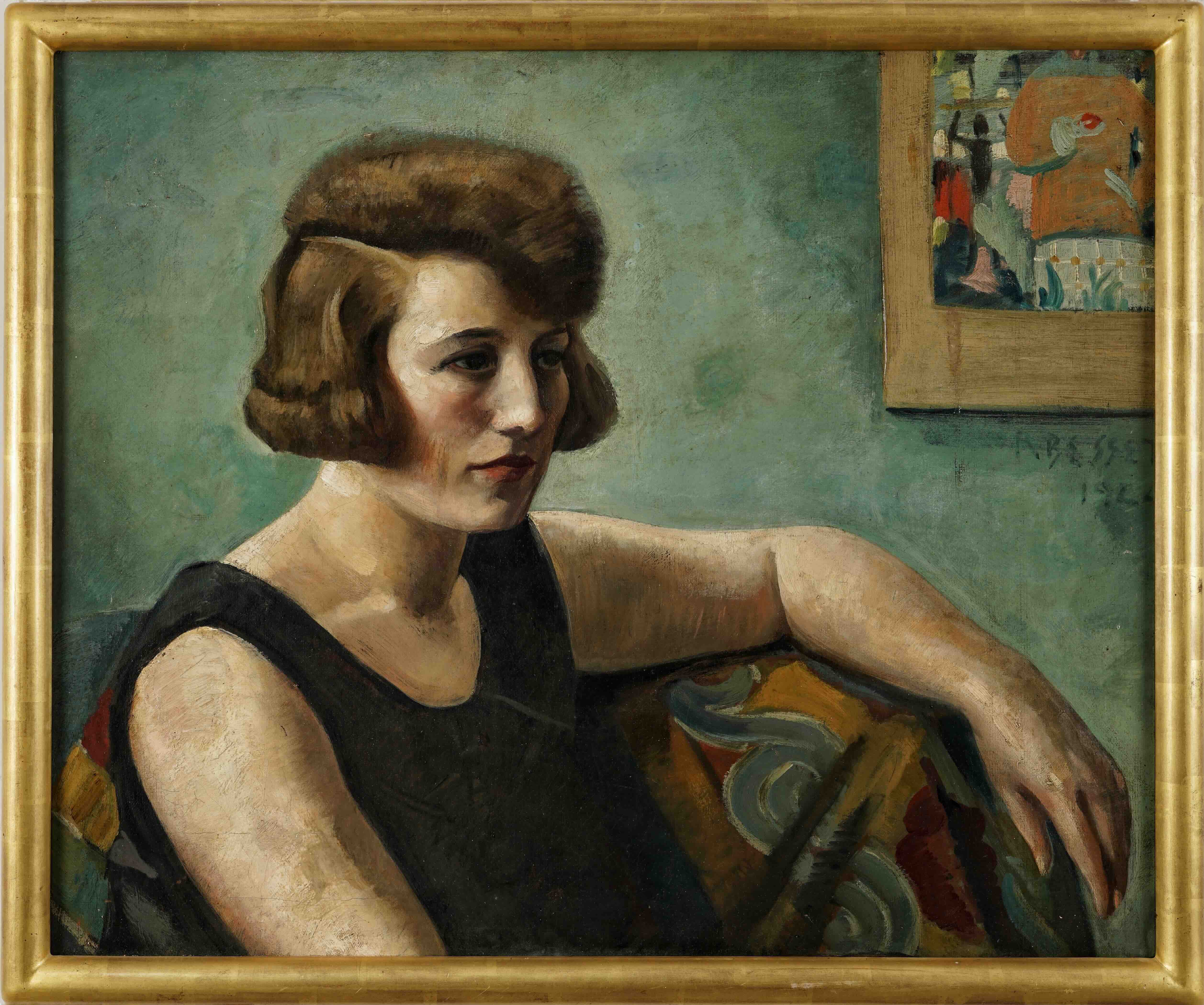
This portrait presents a young woman seated in three-quarter view, her body turned towards the viewer and one arm resting along the chair. Her direct gaze gives the portrait a quiet sense of confidence and self-possession. The figure occupies the centre of the composition against a muted green-blue wall, while the framed picture in the upper right introduces a secondary point of interest without disturbing the overall balance. The painting reflects the restrained elegance of interwar portraiture, combining a modern sense of design with traditional representation. Besset’s handling varies across the surface. Most passages are smoothly and carefully finished, while the hair and arms are treated with slightly thicker paint, adding greater texture. The black dress is rendered as a dense, matte area of colour that gives weight to the lower half of the composition. The structure of the portrait is notably stable and frontal. Firm contours and controlled shadows give the face and arms a sculptural quality, while the overall arrangement has a clear geometric order. This may reflect Besset’s training in both painting and architecture, as well as the wider influence of Cézanne on early twentieth-century artists seeking greater solidity and structure in the figure. The sitter’s coiffure and fashionable dress place the work in the late 1920s or early 1930s, when Besset was exhibiting with Les Nouveaux and developing his mature style. The result is a portrait that combines careful observation with a simplified, modern treatment of form, giving the sitter both elegance and a strong sense of presence.
About the Artist
René Besset (1900–1980) was a French painter whose career unfolded across the turbulent and transformative decades of twentieth-century European art. Born in Lyon on May 3, 1900, he trained at the École des Beaux-Arts de Lyon beginning in 1915, before entering the French army in 1920. In February 1928, he travelled to Italy with fellow artist Pierre Pelloux, a journey that proved formative to his developing artistic vision. Besset was affiliated with the artist collective Les Nouveaux, exhibiting portraits and compositions at the Salon des Indépendants between 1927 and 1929. Early in his career, he was influenced by Amedeo Modigliani, though he quickly developed a distinctive personal style characterised by rigorous formal structure and psychological penetration. His oeuvre encompassed portraiture, figure studies, particularly sumptuous nudes noted for their subtle flesh tones and sensual treatment of light, as well as still lifes and architecturally structured landscapes. During 1941–1942, Besset lived in Lyon before returning definitively to Paris, where he established himself at Cité Falguière. His work was exhibited in Paris, Lyon, Bourges, Barcelona, and Ibiza. Besset married Claude Colette Scibor-Rylski, Comtesse Rylska, in 1947. He died in Paris on October 9, 1980, leaving behind a body of work characterised by an unwavering commitment to the direct observation of life and form.



 CN
CN