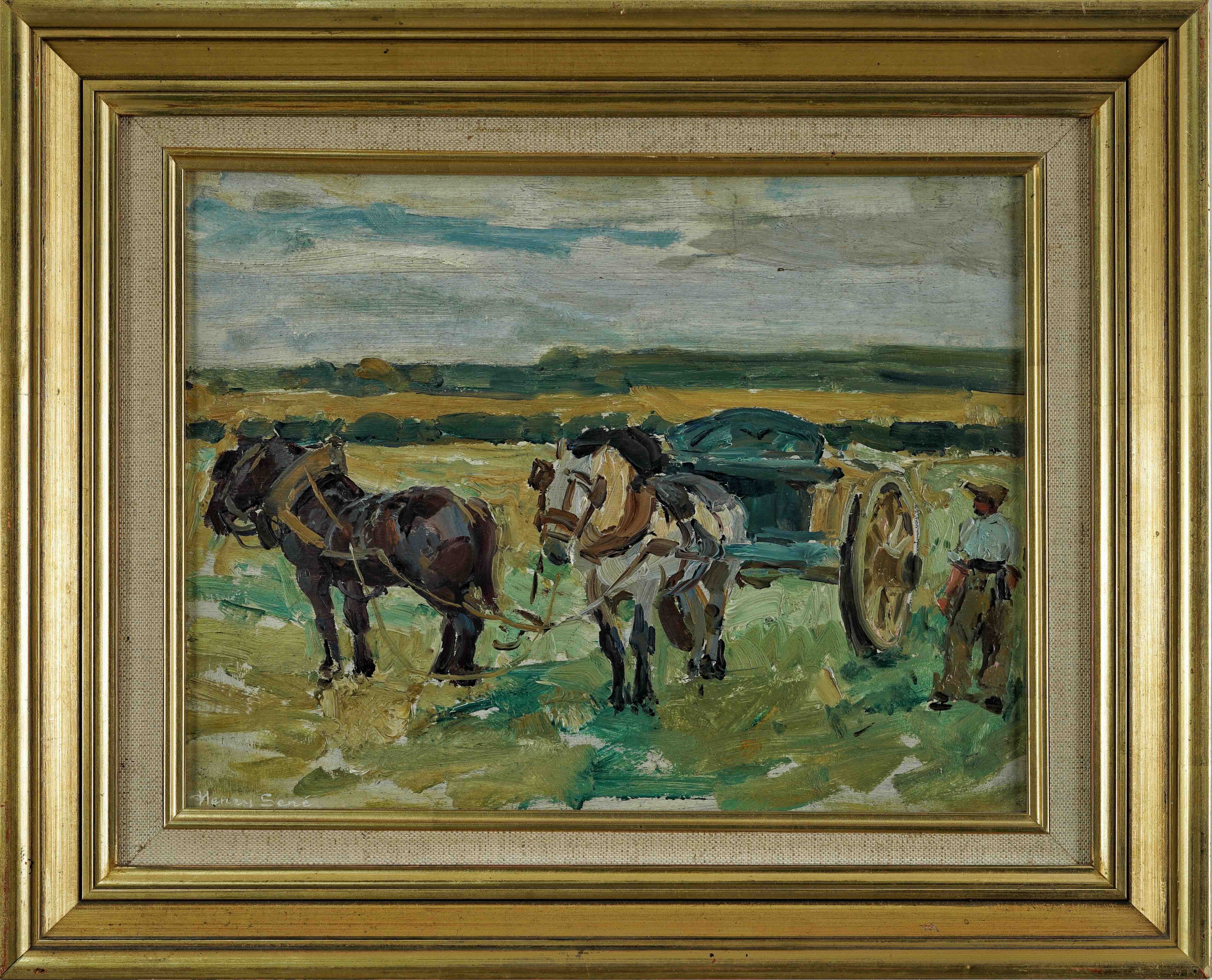
Medium: Oil on panel
Dimensions: 27 x 35 cm
Signature: Signed lower left
Period of execution: c. 1889-1961
Price: ¥15,900
This rural scene reflects a way of life shaped by manual labour, working animals, and the changing agricultural seasons. Painted in earthy tones and softened by an overcast light, it offers a quiet view of everyday life in the French countryside. Two harnessed horses occupy the centre of the composition, while a figure in the background appears to prepare or observe the work taking place around them. Séné’s handling of the landscape shows a clear affinity with the work of Paul Cézanne. Like Cézanne, who repeatedly returned to the landscape of his native Provence, Séné approaches the countryside as a familiar and closely observed subject. The connection is especially visible in his brushwork. Thick paint is applied in short, directional strokes that break the landscape into a series of interlocking patches rather than modelling it through smooth transitions of light and shadow. This approach recalls Cézanne’s Avenue at Chantilly (National Gallery, London) (Fig. 1), where depth is constructed through carefully placed strokes of colour. Séné similarly builds the composition from muted greens, ochres, blues, and touches of white. Warm brown and ochre tones define the horses, while cooler turquoise and green passages open up the middle ground. Blue, grey, and yellowish tones suggest the subdued light of an overcast day. The alternation between warmer earth colours and cooler greens also helps create a gentle sense of recession across the landscape. Darker touches of ochre and vermilion pick out the figures, horses, and the wheel at the right, bringing structure to an otherwise loosely painted scene. Through this combination of strong brushwork and carefully balanced colour, Séné gives an ordinary rural subject a distinctive sense of atmosphere and presence.
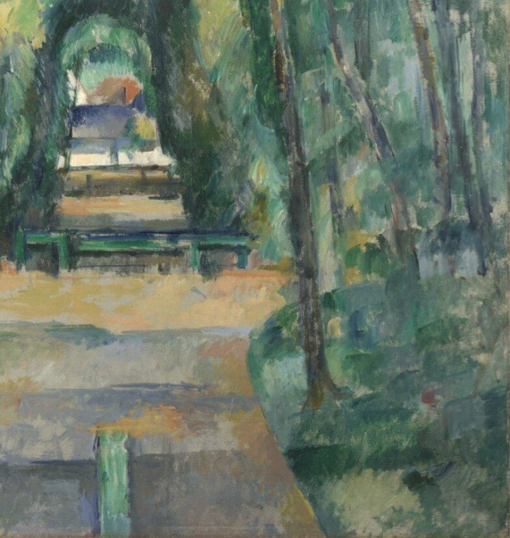
(Fig. 1) Paul Cézanne, Avenue at Chantilly, 1888, oil on canvas, © The National Gallery, London
Henri Séné (1889–1961) was a French painter whose work combined academic training with a freer, more impressionistic approach to light and colour. Active during the first half of the twentieth century, he painted landscapes, rural life, portraits, and scenes encountered during his travels, often using vigorous brushwork and carefully structured compositions. Séné first trained at the School of Arts and Crafts in Châlons-sur-Marne before entering the École des Beaux-Arts in Paris in 1906. He exhibited regularly at the Salon des Artistes Français, receiving an honourable mention in 1913, a silver medal in 1922, and a gold medal in 1932. In 1924, he was also awarded the Prix Rosa Bonheur.
Although his technique remained grounded in academic practice, Séné increasingly adopted the looser handling and interest in atmosphere associated with Impressionism and Post-Impressionism. His rural scenes are particularly attentive to changing light, agricultural labour, and the everyday life of the French countryside. Travel also played an important role in his career. Séné worked across Morocco, the Congo, Brazil, Peru, and Bolivia, broadening both his palette and his range of subjects. These journeys resulted in paintings of North African landscapes, markets, caravans, and South American towns and villages, alongside his better-known French rural scenes. Later in his career, Séné directed the painting studio at the School of Fine Arts in La Paz, Bolivia, extending his involvement in art beyond his own practice. His varied body of work reflects both the academic foundations of his training and a sustained interest in landscape, travel, and everyday life.



 CN
CN