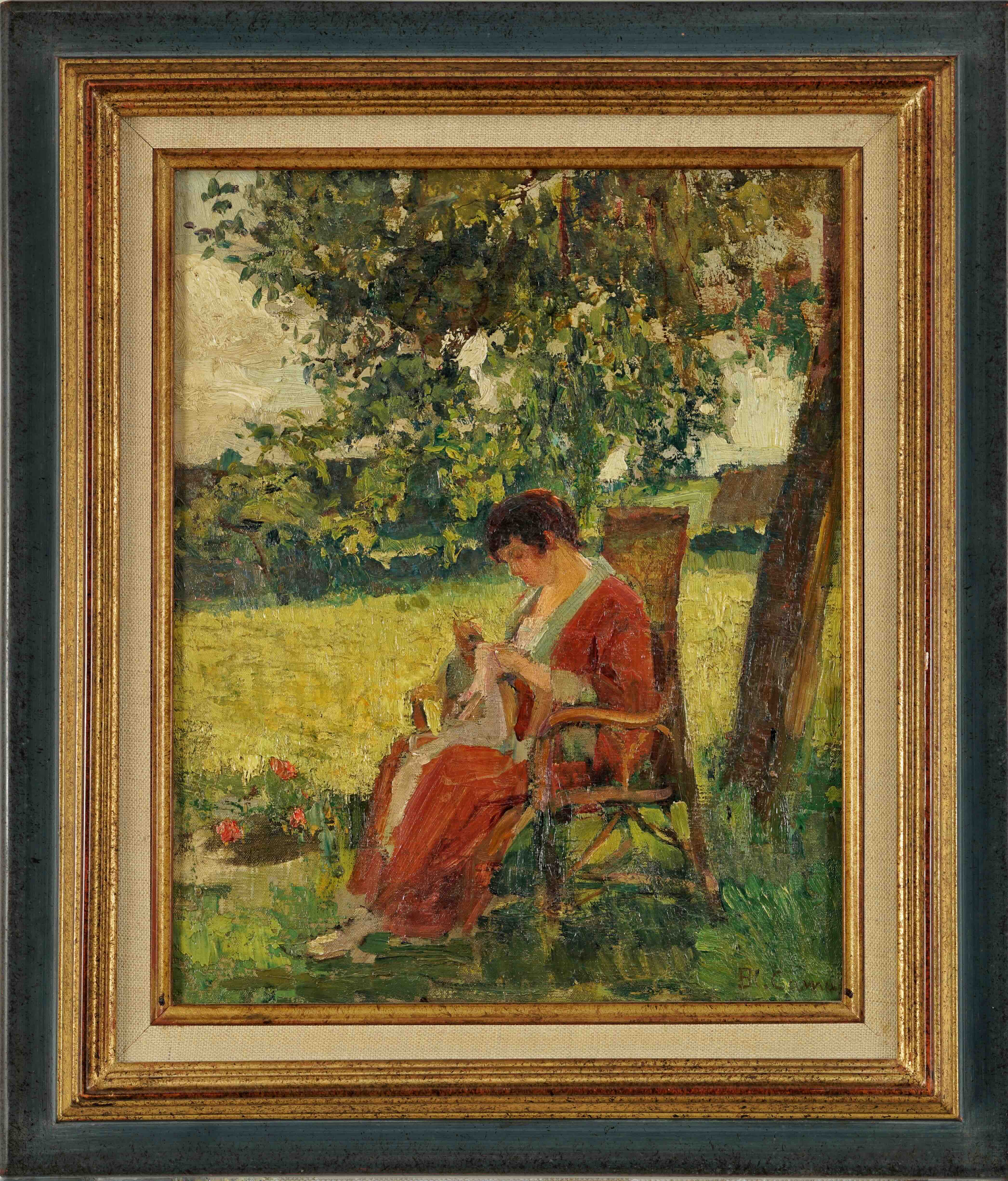
Medium: Oil on canvas
Dimensions: 41 x 33.5 cm
Signature: Signed lower right “Bl Camus”
Period of execution: c. 1884-1968
Price: ¥46,500
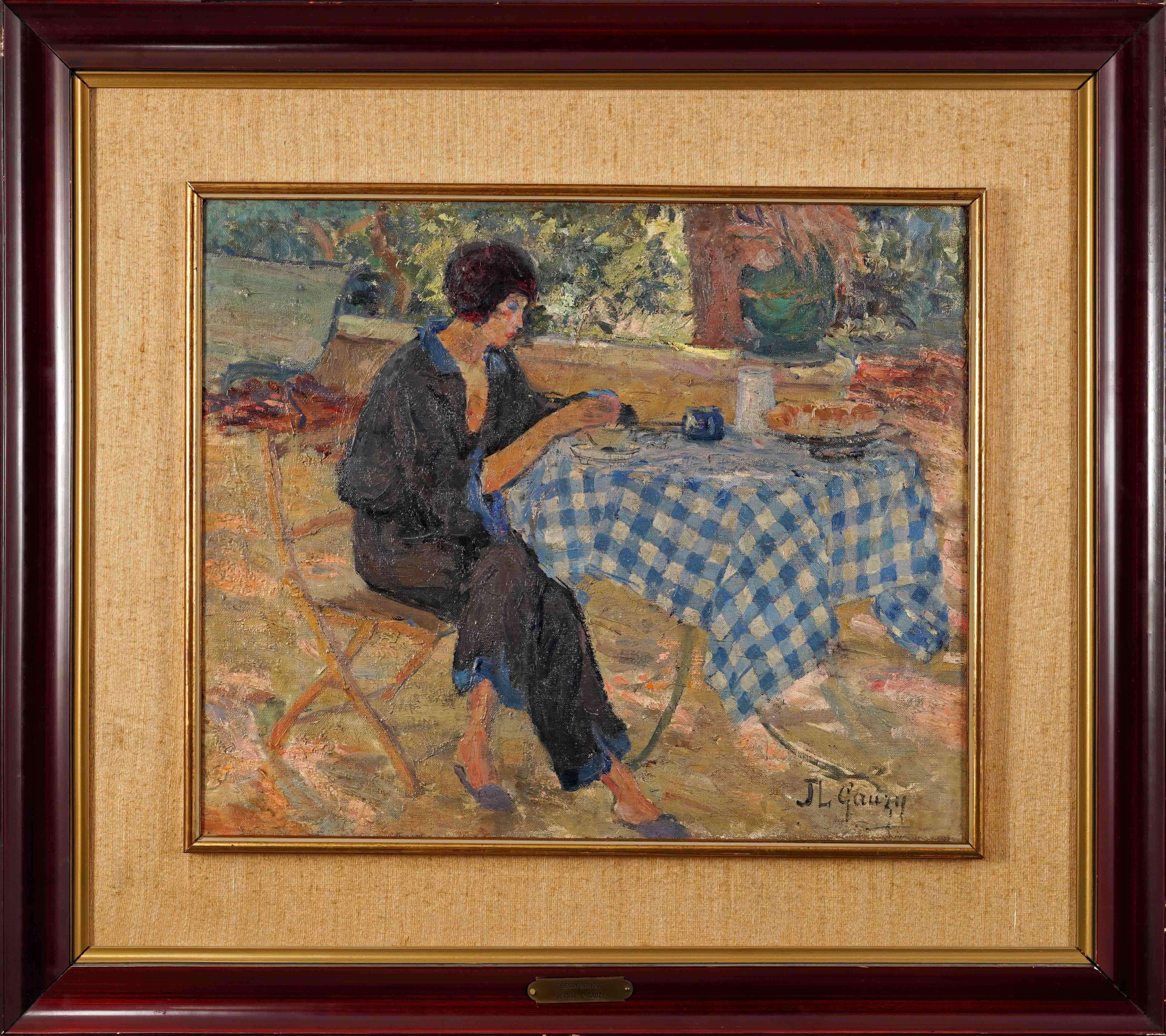
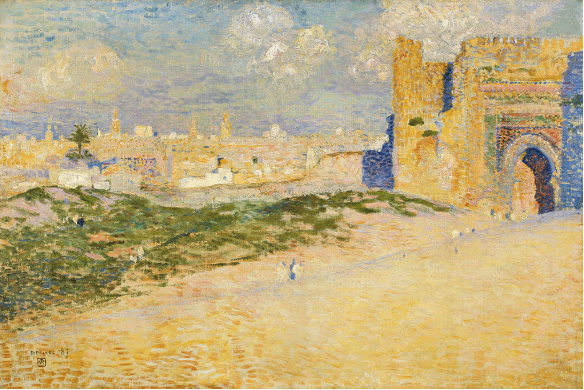
This work reflects Blanche Augustine Camus’s sensitivity to southern light and the quiet intimacy of outdoor life. A woman sits sewing beneath a tree, surrounded by dense vegetation and softened by the shade of the canopy above. The scene is modest in subject, but carefully observed in its treatment of colour, light, and atmosphere. Although Camus is closely associated with Divisionism and the Neo-Impressionist tradition, the handling here is notably freer than the systematic pointillism of Georges Seurat. Her brushwork recalls the later paintings of Théo van Rysselberghe, particularly works such as The El Khemis Gate in Meknes in the Thyssen-Bornemisza National Museum (Fig. 1). Both artists retained an interest in divided colour while allowing the individual brushstroke to become more fluid, varied, and expressive. This can be seen particularly in the tree canopy and the receding grass, where short, broken strokes create a lively surface. The sky is built from layered passages of blue, with the texture of the paint deliberately left visible. Rather than smoothing these areas into a uniform field, Camus allows each touch of colour to remain distinct, giving the surface both optical brightness and a tactile quality. Her treatment of yellow is especially important to the painting’s luminosity. Warm yellow and citrus tones run through the grass, foliage, and shaded areas, preventing the shadows from becoming heavy or dull. Even beneath the tree, the scene retains a sense of warmth, as though sunlight continues to filter through the surrounding leaves. This quality was recognised by the critic André Warnod, who praised Camus’s ability to fill her paintings with warm, vibrant sunlight. Camus therefore adapts Divisionist ideas to a more personal and flexible manner of painting. Complementary colours remain important to the construction of light and shadow, but they are combined with freer brushwork and a stronger emphasis on the physical surface of the paint. The result is a style that retains the colouristic brightness of Neo-Impressionism while responding closely to the luminous atmosphere of the South of France.
Blanche Augustine Camus (1884–1968) was a French Neo-Impressionist painter associated with Divisionism, celebrated for her luminous depictions of southern French landscapes and gardens, often combined with graceful outdoor portraits of family and friends. Born in Paris on October 27, 1884, she studied at the Académie Julian and the École des Beaux-Arts from 1902 to 1908 under Tony Robert-Fleury, Jules Joseph Lefebvre, and Adolphe Déchenaud. Camus first exhibited at the Salon des Artistes Français in 1911 and continued to show there until 1939, winning the gold medal in 1920. She eventually settled in the South of France, where she developed a distinctive style centered on gardens, terraces, and sun-drenched landscapes. Her work is characterised by an exploration of Mediterranean light and colour, employing broad, expressive brushstrokes aligned with Post-Impressionist aesthetics. Her compositions show a consistent preference for simple, intimate subjects, including portraits and quiet natural settings characterised by warmth and serenity. Camus’s work is represented in museum collections internationally, including the Indianapolis Museum of Art at Newfields, which holds her painting Flowers. In France, examples of her work can be found in several regional collections, among them the Musée des Beaux-Arts in Besançon, the Musée Denon in Chalon-sur-Saône, the Musée de la Chartreuse in Douai, the Musée des Beaux-Arts in Lyon, the Musée des Beaux-Arts in Pau, and the Musée des Beaux-Arts in Nice. She is particularly associated with scenes of southern France, where her interest in Mediterranean light, everyday life, family intimacy, and sunlit landscape gives her work its distinctive character.



 CN
CN