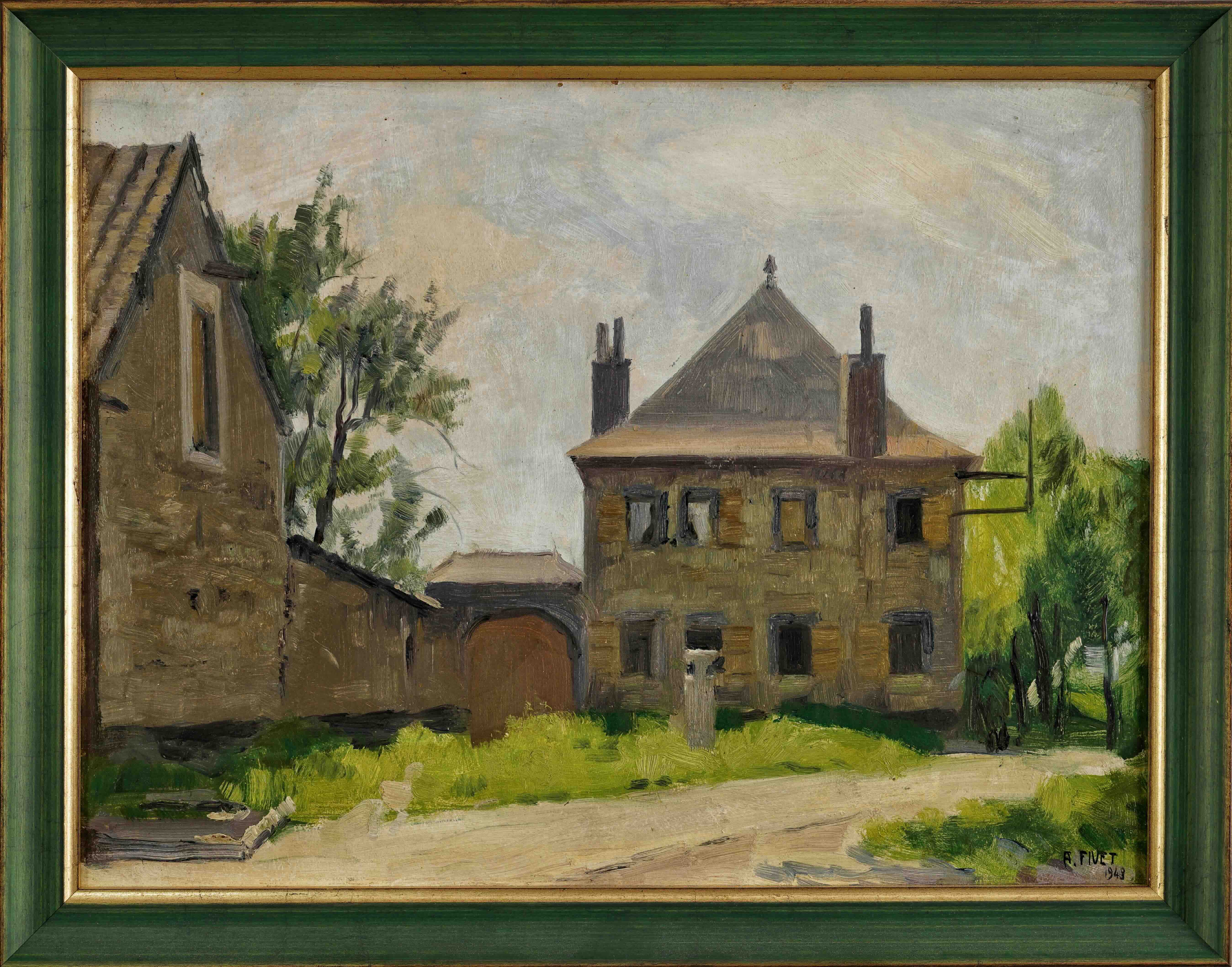
Medium: Oil on cardboard
Dimensions: 30 × 40 cm
Signature: Signed lower right
Period of execution: c. 1882-1954
Price: ¥ 5,300
Dated 1948, this work by Alexis Fivet depicts a quiet French village scene centred on a stone house approached by a narrow path and surrounded by dense vegetation. Soft, diffused light falls across the façade and ground, creating gentle shadows and giving the composition a calm, closely observed atmosphere. Painted during the later years of the Liège School’s most active period, the work combines a direct response to landscape with a lingering Romantic sensitivity to place and mood. Fivet’s handling of paint shows a clear affinity with Alfred Sisley, particularly in the loose and immediate treatment of light. A useful comparison can be made with Sisley’s The Watering Place at Marly-le-Roi in the National Gallery, London. In both works, thinly applied paint and visible brushstrokes give the surface a sense of freshness. Fivet lightly drags pale pigment across the sky and pathway, allowing the warmer ground beneath to remain visible and contribute to the overall tonality. The architecture is treated with particular attention to texture. Rather than describing the stonework in precise detail, Fivet allows the brushwork itself to suggest the irregular surface of the masonry. The composition appears to have been established first with thin, diluted paint before being developed through layered ochres, mauves, greens, and muted yellows. Smaller details are then worked directly into the still-wet surface, preserving a sense of immediacy. The foliage is handled with lighter, feathery strokes, especially in the tree canopy, where broken touches of colour suggest the movement of light through leaves. Through this combination of loose brushwork, subtle colour variation, and close observation, Fivet gives an ordinary village subject a quiet luminosity and strong sense of place.
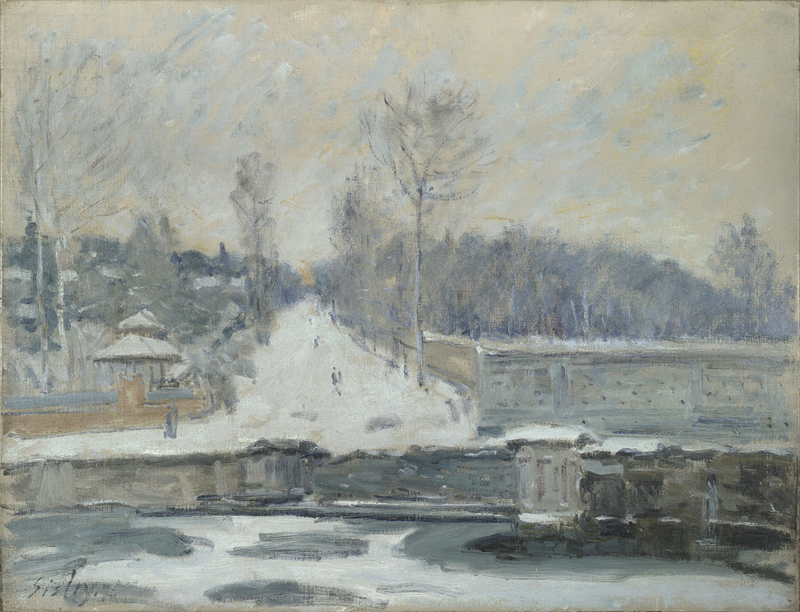
(Fig. 1) Alfred Sisley, , 1875, The Watering Place at Marly-le-Roi, National Gallery, London
Alexis Fivet (1882–1954) was a Belgian artist who worked across painting, pastel, engraving, and sculpture, and is closely associated with the Liège school of landscape painting. Liège and its surrounding region became an important centre for landscape art from the late nineteenth century onwards, particularly following the appointment of Évariste Carpentier as professor at the local academy. His teaching helped shape a generation of artists who approached the landscape through close observation, atmospheric effects, and a strong sense of place. Fivet developed his practice during one of the Liège School’s most active periods. Like many artists connected with the movement, he was drawn to the Belgian countryside and to the changing effects of light, weather, and season. His work combines naturalistic observation with a more poetic treatment of landscape, favouring mood and atmosphere over strict topographical description. His versatility across oil, pastel, printmaking, and sculpture also gave his practice a broader technical range than many of his contemporaries. Across these media, however, his work remained closely tied to the landscape tradition that defined the Liège School.



 CN
CN