About the Artwork
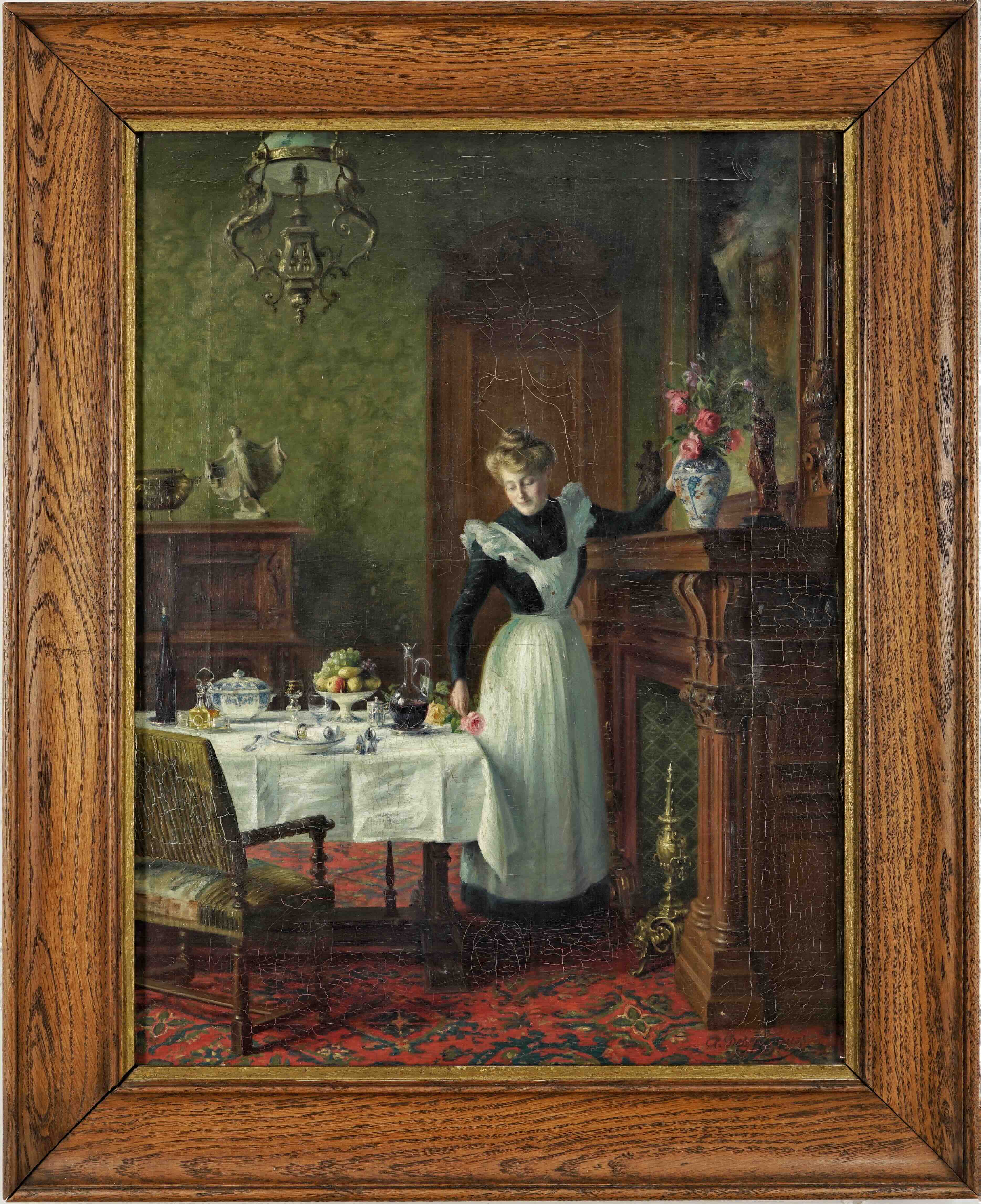
This refined interior scene captures a quiet moment of domestic life in a prosperous Belle Époque household. A young woman in a white apron stands reading within an elegantly furnished room, surrounded by dark wood panelling, decorative objects, and carefully arranged furniture. In the foreground, a table set for tea introduces a brighter note: its white cloth catches the light, while a vase of pink flowers adds colour to the otherwise subdued interior. Desplanques’s academic training is evident in his close attention to different surfaces and materials. Polished wood, crisp linen, upholstery, and fabric are each distinguished through careful changes in texture and tone. Soft, diffused light enters from outside the composition, gently modelling the forms and creating depth without relying on strong contrasts of light and shadow. The setting also reflects the domestic ideals associated with the Belle Époque, when well-appointed interiors became closely linked with comfort, refinement, and cultivated middle-class life. Rather than presenting a grand social occasion, however, Desplanques focuses on an ordinary private moment, giving equal attention to the figure and the surrounding objects. In this respect, the painting belongs to a longer tradition of domestic interior painting. Its quiet atmosphere, carefully ordered composition, and interest in everyday activity recall the seventeenth-century Dutch and Flemish painters who similarly treated domestic life as a subject worthy of close observation.
About the Artist
Alfred Desplanques (1853–1930) was a French painter from Tourcoing, celebrated for his realistic portraits and genre scenes depicting everyday life in northern France. The artist was given a nickname "Le Broutteux de la peinture" (The Browsing Painter) by poet Jules Watteeuw. Desplanques trained under Jean-Joseph Weerts and the renowned portraitist Émile-Auguste Carolus-Duran. His work is distinguished by meticulous attention to detail and sincere observation of local people and their quotidian activities, rendered in a manner consciously evoking seventeenth-century Flemish and Dutch genre painting. Drawing inspiration from domestic and bourgeois interiors, Desplanques developed a style characterised by warm atmosphere, careful execution, and a sensitive treatment of light. His works remain relatively scarce on the market and are appreciated for their technical refinement and intimate portrayal of everyday life in regional France.



 CN
CN