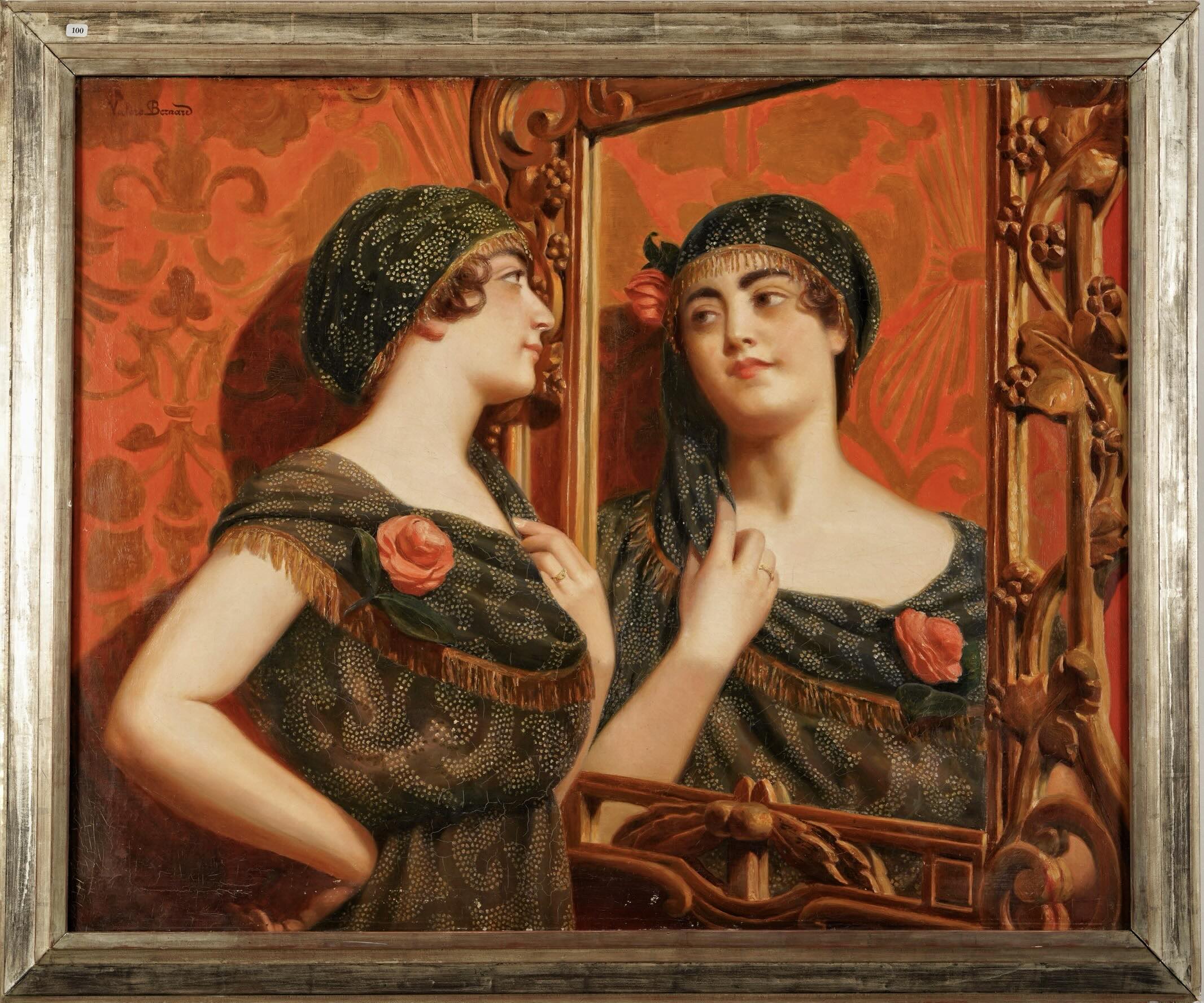
Medium: Oil on canvas
Dimensions: 73.5 x 92 cm
Signature: Signed upper left
Period of execution: c. 1860-1936
Price: ¥54,300
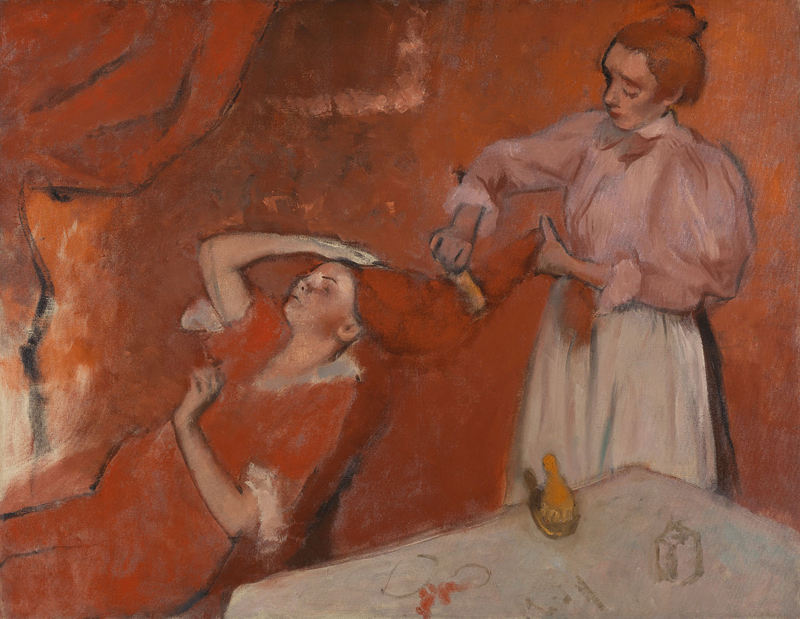
This intimate composition shows an elegantly dressed young woman in profile, holding a vivid red rose as she looks toward her reflection in an ornate mirror. The painting gains much of its tension from a subtle visual contrast: the reflected figure appears to look directly outward, while the woman herself seems to gaze beyond the frame. This small disjunction gives the familiar motif of a woman before a mirror a more reflective character, suggesting a contrast between outward appearance and private thought. Her clothing helps place the work within the changing fashions of the 1910s and early 1920s. The dress moves away from the tightly corseted silhouette of the previous century towards the looser, straighter forms associated with designers such as Paul Poiret. Its broad draped neckline exposes the shoulders, while the lightweight fabric, possibly chiffon or Georgette over a darker lining, is decorated with gold details and fringe. These ornamental elements reflect the wider taste for Orientalist and Art Deco-inspired decoration in fashionable dress of the period. The composition is dominated by a rich orange-red palette that recalls Edgar Degas’s later work, particularly La Coiffure (National Gallery, London) (Fig. 1). In Degas, similarly intense colour heightens the atmosphere of an otherwise private, domestic scene. Marius uses colour with comparable boldness, although here the effect is gentler and more contemplative. The surrounding red seems to echo the woman’s mood, giving the scene a sense of warmth, intimacy, and inward absorption. Together with the mirror and the rose, it reinforces the impression of a figure caught between self-awareness and reverie.
Valère Bernard François Marius (1860–1936) was a Provençal painter, printmaker, novelist, and poet who worked in both French and Occitan. Born in Marseille to a family originally from Avignon, he began his artistic training at the age of fifteen under Joanny Rave at the École des Beaux-Arts in Marseille, before continuing his studies in Paris with Alexandre Cabanel and Pierre Puvis de Chavannes.
His work as a printmaker developed significantly after his discovery of Félicien Rops in 1896, whose dark symbolism and graphic language had a lasting influence on his approach to engraving. Marius was also a friend of Alfons Mucha, who introduced him to lithographic poster design. Among his most notable graphic works is the series Guerro (1893–1895), a group of prints centred on the theme of death and indebted in part to Francisco Goya. Alongside printmaking, Marius worked across painting, decorative art, literary illustration, and writing. Although his career remained closely associated with Provence, the breadth of his practice and the continued publication of his graphic work after his death reflect the distinctive place he occupied within the artistic and literary culture of southern France.



 CN
CN