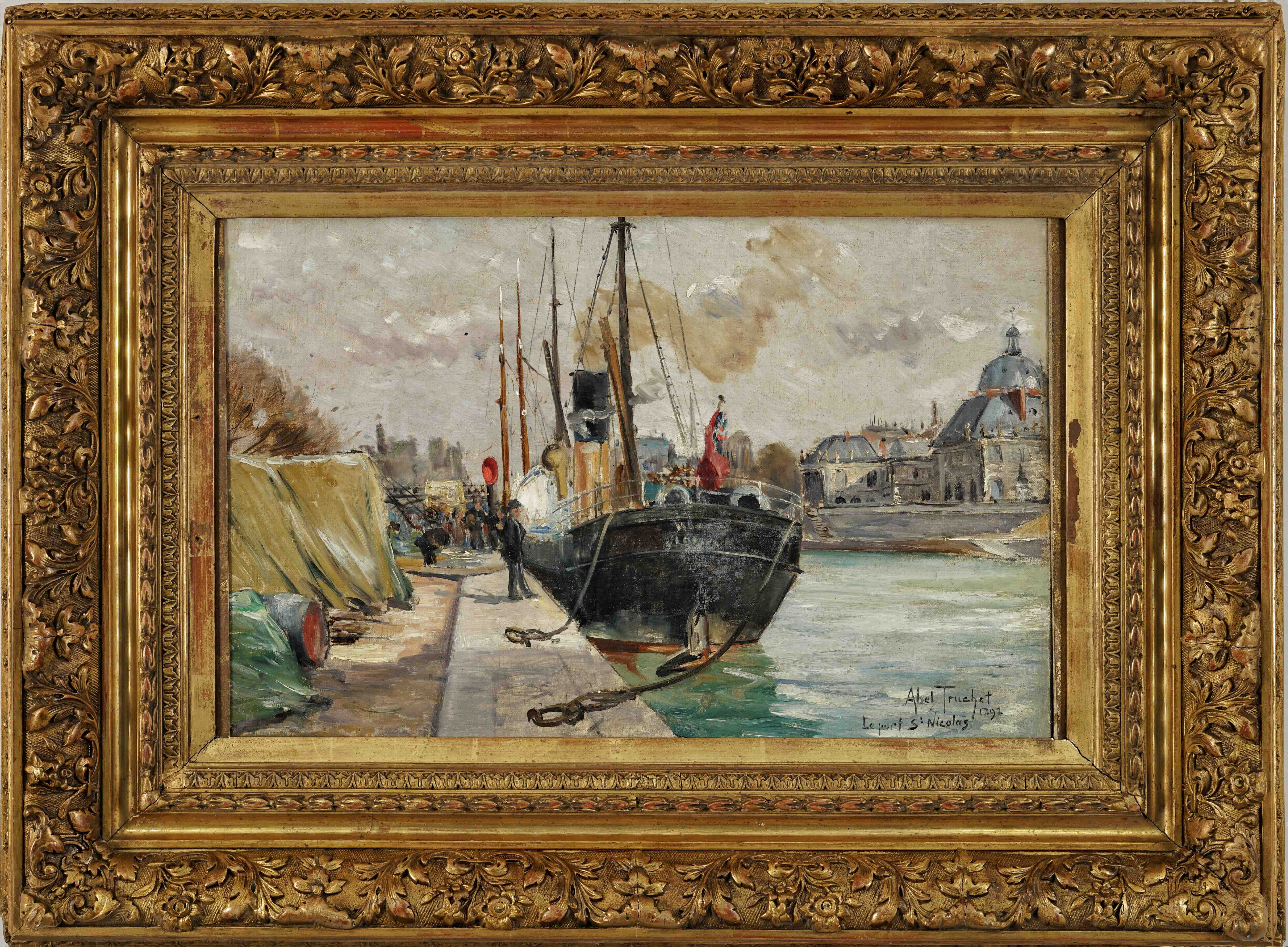
Medium: Oil on canvas
Dimensions: 31 x 47 cm
Signature: Signed lower right
Period of execution: c. 1857-1918
Price: ¥65,100
Dated 1893, this view of the Port Saint-Nicolas shows Abel-Truchet’s accomplished handling of both the Parisian riverfront and the changing atmosphere of the Seine. A moored sailing vessel with a dark hull occupies the foreground, its masts and rigging rising against the hazy skyline and giving the composition a strong vertical rhythm. Sailors, workers, chimneys, and distant buildings introduce a sense of activity, while the muted palette of silvery greys, soft ochres, and cool blues conveys the damp, diffused light of the riverside. The former Port Saint-Nicolas was situated on the right bank of the Seine, immediately below the Louvre, and was also known as the Port du Louvre or Port du Musée. It served as a landing and unloading point for goods arriving in central Paris by river. From this position, Abel-Truchet looks upstream and across towards the left bank, where the dome of the Institut de France rises prominently beyond the Seine, close to the Pont des Arts. This surviving landmark makes it possible to locate the viewpoint with unusual precision and connects the painting directly with a part of Paris that remains recognisable today, even though the port itself has since disappeared and the riverfront has changed considerably.
Abel-Truchet paints the scene with fluid, economical brushwork. Masts are reduced to quick linear strokes, figures are suggested with only a few touches of paint, and the water and sky merge into broad, luminous passages. Rather than describing every detail, he concentrates on the overall atmosphere of the working river. A similar approach can be seen in Aux Champs-Élysées at the Musée Carnavalet (Fig. 1), where a restrained palette and loose handling are used to suggest figures moving beneath the trees. In both works, individual details remain secondary to the broader impression of light, movement, and urban life. The painting also gains interest from Abel-Truchet’s later role in the changing Paris art world. In 1903, he was among the artists involved in the foundation of the Salon d’Automne, created as an alternative to the more conservative established salons. The new exhibition provided an important platform for contemporary artists and soon became associated with some of the major developments of early twentieth-century French painting, most famously Fauvism. Although Abel-Truchet is less widely known today than some of the artists who later exhibited there, his involvement in the Salon d’Automne places him within the artistic circles that contributed to the renewal of exhibition culture in Paris at the beginning of the twentieth century.
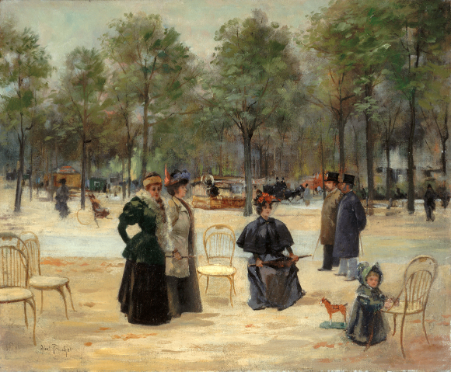
(Fig. 1) Abel-Truchet, Aux Champs-Élysées, 1895, oil on canvas, © Musée Carnavalet, Histoire de Paris
Louis Abel-Truchet (1857–1918) was a French painter and poster artist celebrated for his depictions of Parisian nightlife, urban landscapes, and genre scenes capturing the vitality of Belle Époque Paris. Abel-Truchet first exhibited publicly in 1891 and quickly established himself within progressive artistic circles. He was among the founding exhibitors at the inaugural Salon d'Automne in 1903, aligning himself with artists seeking alternatives to the conservative official Salon. By 1910, he had gained sufficient recognition to become a member of the Société Nationale des Beaux-Arts, and the following year, he was named a Knight in the Legion of Honour, affirming his status within the French artistic establishment. During World War I, Abel-Truchet volunteered for military service, receiving the rank of Lieutenant in the 1st Engineering Regiment. The army recognised his artistic skills by appointing him assistant to Guirand de Scévola, head of the newly established Camouflage Division — an innovative military unit that employed artists to develop techniques for concealing military equipment and positions. Shortly before the Armistice, Abel-Truchet was wounded in action and died at a military hospital in Auxerre on September 9, 1918.
In 1919, the Salon d'Automne mounted a memorial exhibition honouring artists who had perished in the war, featuring his works prominently. Today, his paintings are held in several French public collections, particularly the Musée de Grenoble, Musée Carnavalet, Histoire de Paris, and the Musée d'art moderne André-Malraux in Le Havre. A street in Paris's 17th arrondissement bears his name, commemorating his contribution to the visual documentation of Parisian life.



 CN
CN