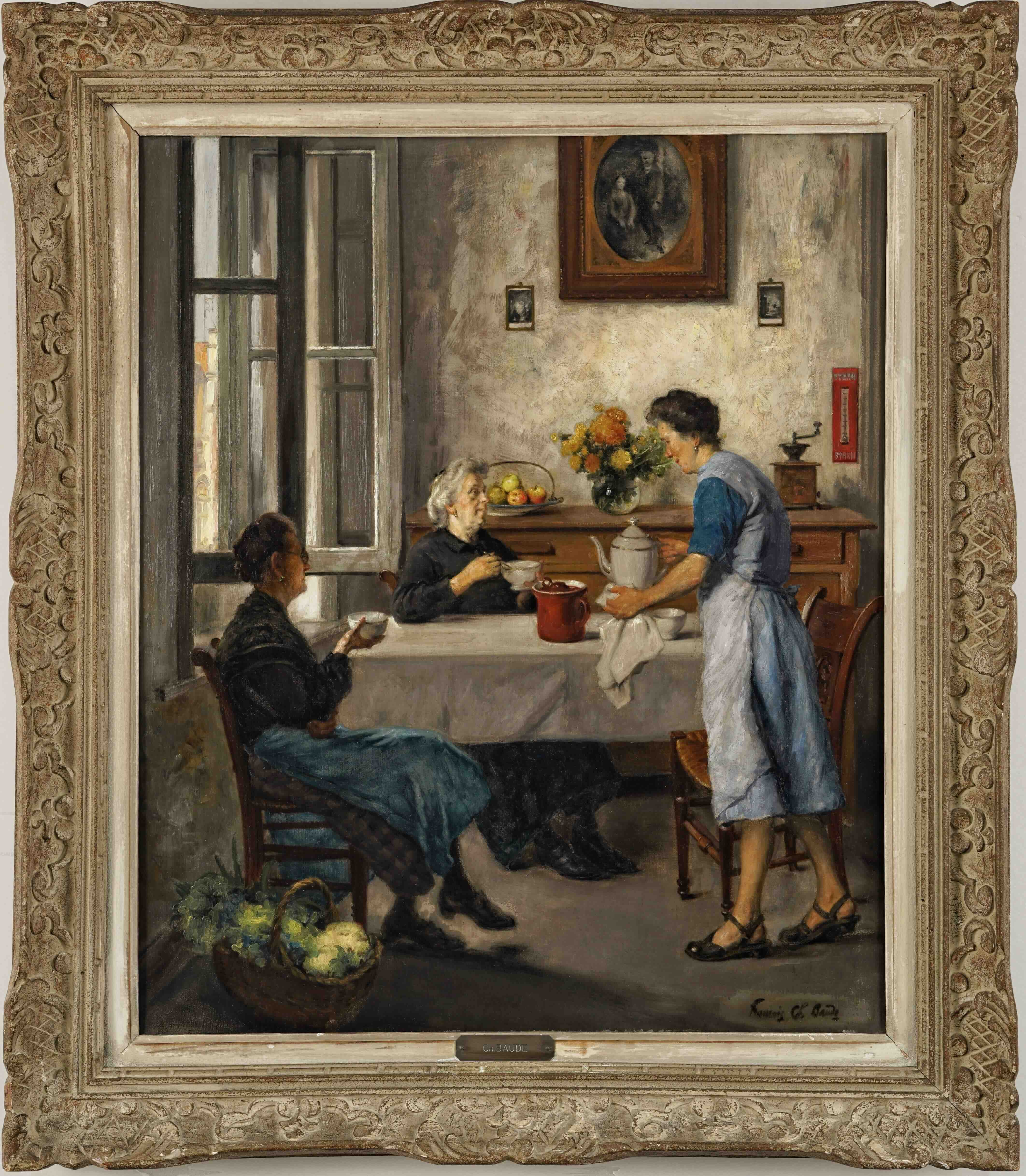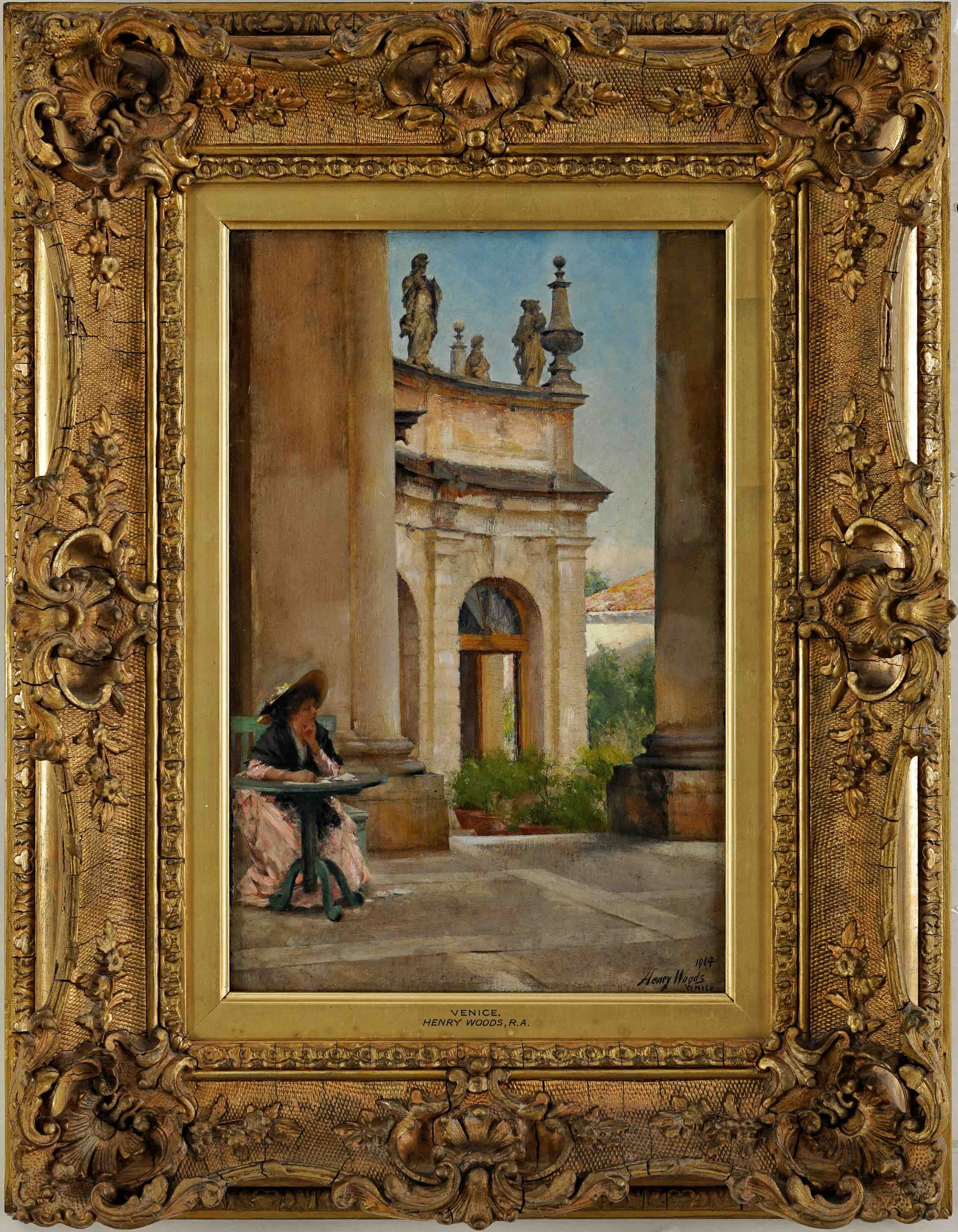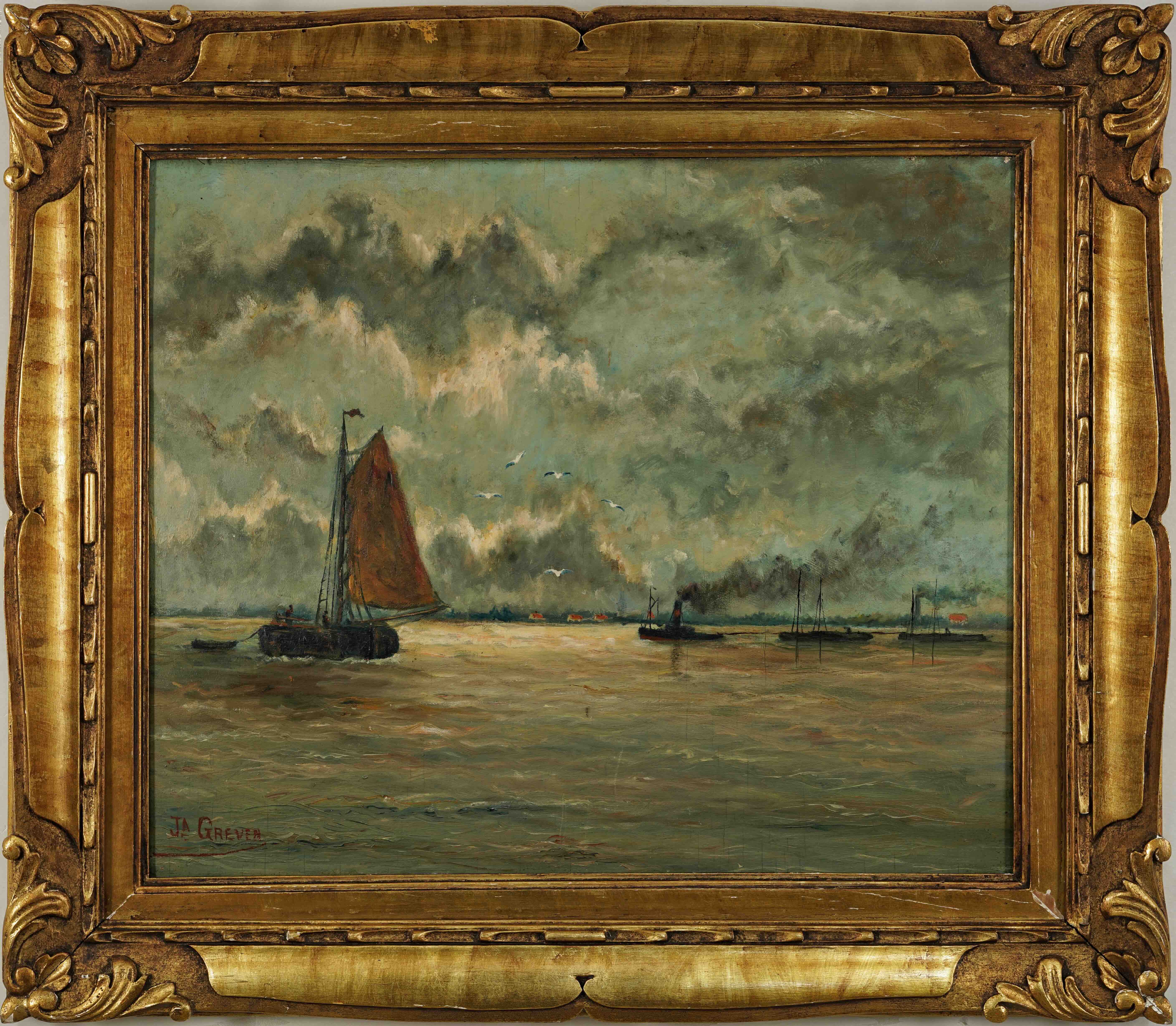
Medium: Oil on panel
Dimensions: 61.5 x 45 cm
Signature: Signed lower right
Period of execution: c. 1890-1960.
Price: ¥50,800
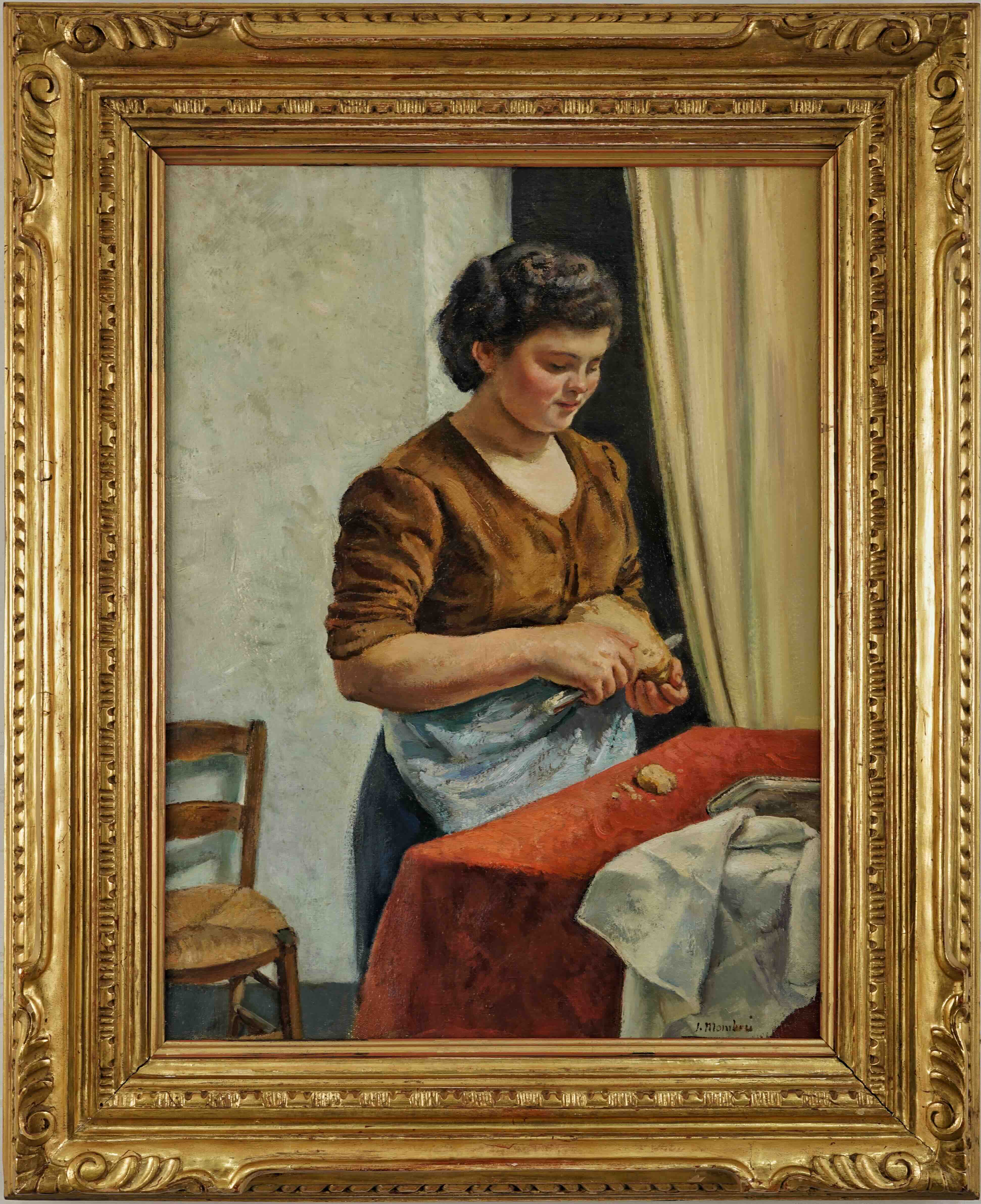
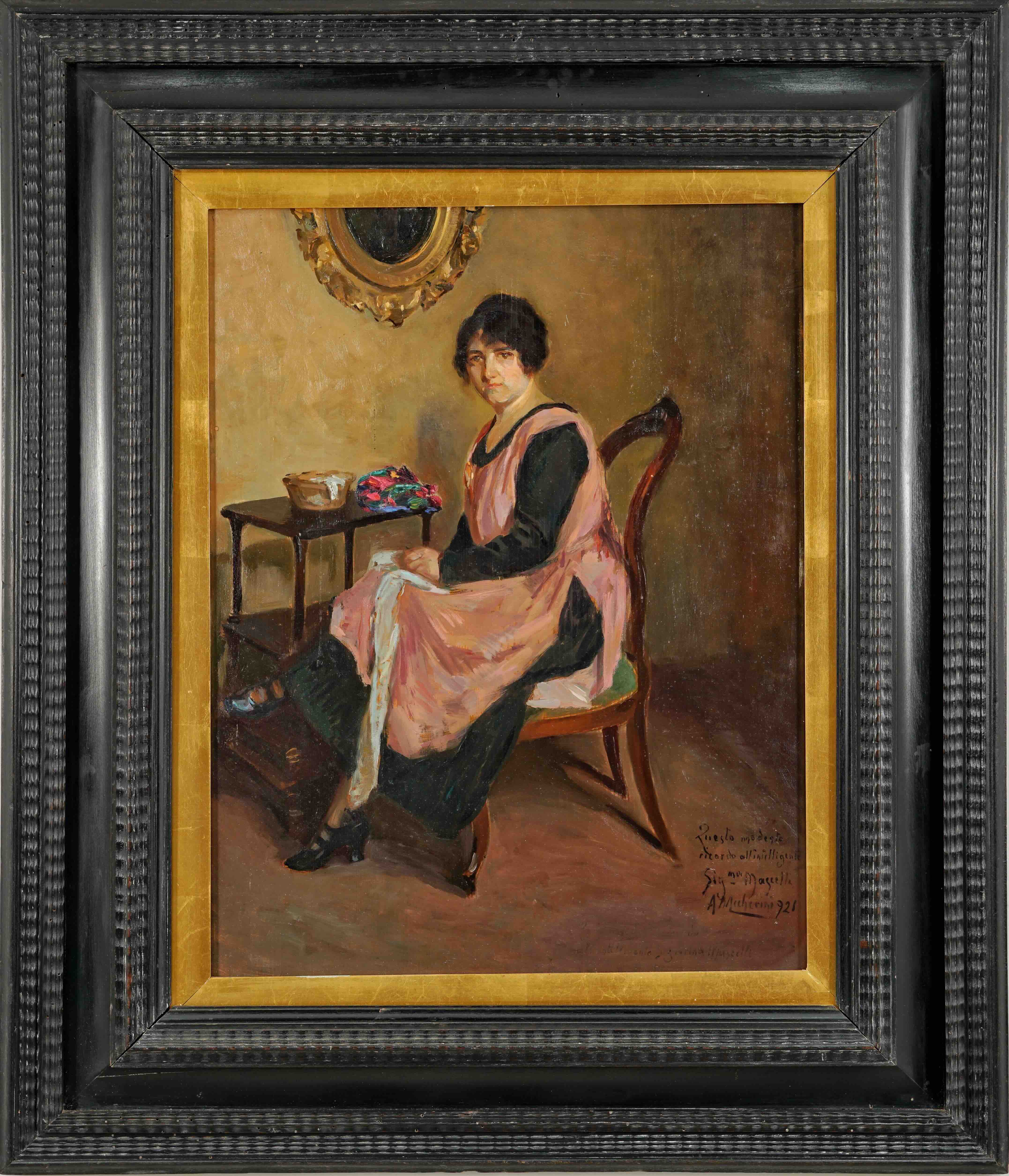
This intimate portrait depicts a woman in a pink work dress surrounded by familiar domestic objects: a table, a gilded oval mirror, and brightly coloured embroidery. Although the setting is distinctly bourgeois and contemporary, the treatment of the figure draws on a much older tradition of portraiture. Her face is modelled with careful realism, using fluid layers of paint, warm rose tones across the cheeks, and cooler blues within the flesh. Together, these colours give the complexion a soft translucency and a polished, almost classical appearance.
This interest in classical form can be considered within the wider artistic climate of early twentieth-century Italy, when the Novecento Italiano sought to renew Italian painting through a return to clarity, solidity, and the traditions of earlier Italian art. Founded in Milan in the 1920s and closely connected to the cultural environment of Fascist Italy, the movement looked particularly to the Quattrocento and Cinquecento as points of reference, while distancing itself from some of the more radical experiments of the European avant-garde. Amelia’s painting shares something of this renewed interest in classical portraiture, although on a more intimate and domestic scale. Her palette recalls aspects of early Renaissance painting. Rather than relying on the deep chiaroscuro associated with Leonardo da Vinci, the face is described through brighter colour and relatively even illumination. The resulting luminosity brings to mind the clearer flesh tones found in works by Sandro Botticelli, such as Venus and Mars (Fig. 1). At the same time, Amelia’s handling of paint remains rooted in the traditions of nineteenth-century academic portraiture, combining Renaissance references with a more modern and tactile surface. A further comparison can be made with Francisco de Goya’s Portrait of the First Duke of Wellington (Fig. 2). Like Goya, Amelia uses small accents of pale paint across the forehead, chin, and around the eyes to articulate the structure of the face. These thicker highlights contrast with the thinner passages across the cheeks and beneath the eyes, giving the sitter a stronger sense of volume and presence. The result is a portrait that brings together classical references, academic technique, and the visual language of twentieth-century Italian painting.
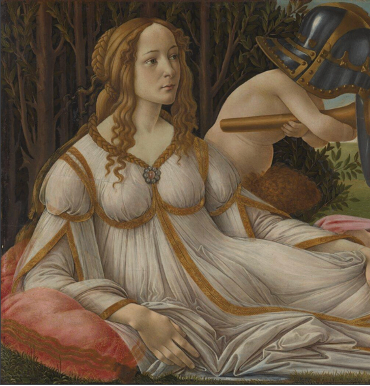
(Fig. 1) Sandro Botticelli, Venus and Mars, c. 1485, tempera and oil on panel, © The National Gallery, London

Amelia Mecherini (1890–1960) was an Italian painter and illustrator based in Florence. She received private instruction at the Accademia di Belle Arti in Florence. Mecherini began exhibiting publicly in 1911 at the Promotrice di Firenze, where she showed Ritratto di mia madre (Portrait of My Mother) and La veglia (The Vigil). She continued to exhibit there regularly, and in 1919 received a prize for Le rassettatrici di Montedomini. Her oeuvre includes Natura Morta (Still Life), a 1942 oil self-portrait now held at the Galleria d'Arte Moderna di Palazzo Pitti in Florence, and a biographical series of twelve oil paintings depicting the life of Padre Lino Maupas, completed in 1933. Among her significant commissions, Mecherini created a triptych in 1922 for the Fondazione Cassa di Risparmio di Firenze, along with additional paintings for its offices. As an illustrator, she collaborated with several prominent publishers. In 1925, she worked with Fratelli Alinari to illustrate an edition of the celebrated Veglie di Neri by renowned Tuscan writer Renato Fucini—a collaboration encouraged by art critic and journalist, Cipriano Giachetti, a consultant to the publishing house and admirer of Mecherini's work. She later illustrated La viandante delle Corti by Olga Visentini for Paravia (1943 and 1950), Six Barons and a Knife Grinder for Franceschini, and The Heroic Life of Father Reginaldo Giuliani for Pozzi (1939). Mecherini maintained an active career spanning decades, participating in international exhibitions and fulfilling numerous commissions for paintings and drawings. According to the Kunsthistorisches Institut in Florence, her output totals over 300 works.
Today, several of her drawings are preserved in the Cabinet of Drawings and Prints at the Uffizi Gallery in Florence, while four paintings are on permanent display at the Galleria d'Arte Moderna in Palazzo Pitti. Her work is also represented in the collection of the Fondazione CR Firenze.



 CN
CN