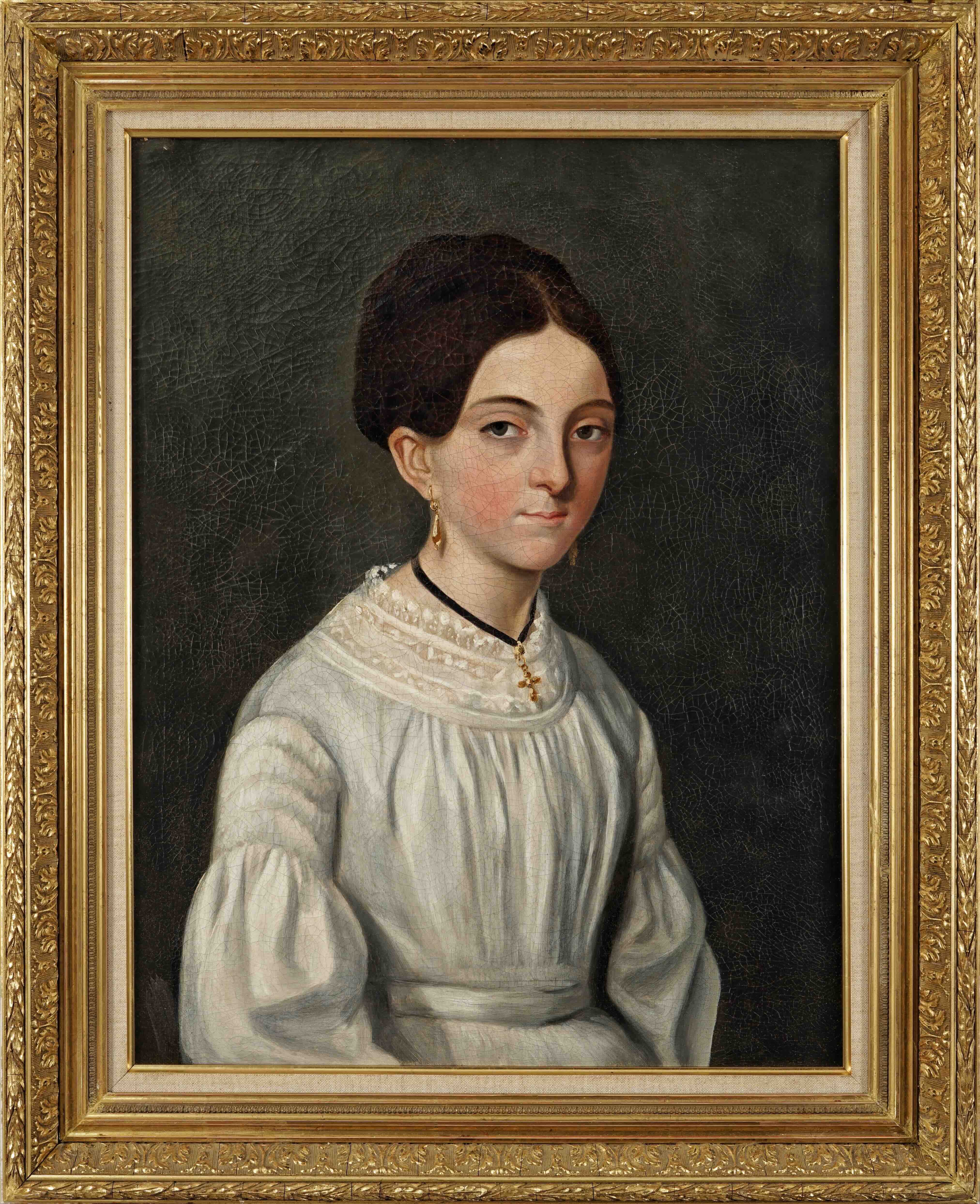
Medium: Oil on canvas
Dimensions: 65 × 50 cm
Signature: Unsigned
Period of execution: c. 1806-1856
Price: ¥ 47,500
While the artist of this portrait remains unidentified, the work clearly belongs to the academic tradition of the late 19th century, embodying the period's established aesthetic principles: frontal presentation, dignified pose, meticulous attention to fabric rendering, and precise feature delineation. This painting presents a young girl, evidently from a prosperous bourgeois household, dressed in an impeccably tailored costume that speaks to her family's social position. The composition demonstrates sophisticated technical mastery through its treatment of the dark background, which achieves spatial depth without relying on traditional shadow modelling — a hallmark of 19th-century academic portraiture that draws inspiration from Dutch Baroque aesthetics, particularly Rembrandt's influential approach to portrait composition.
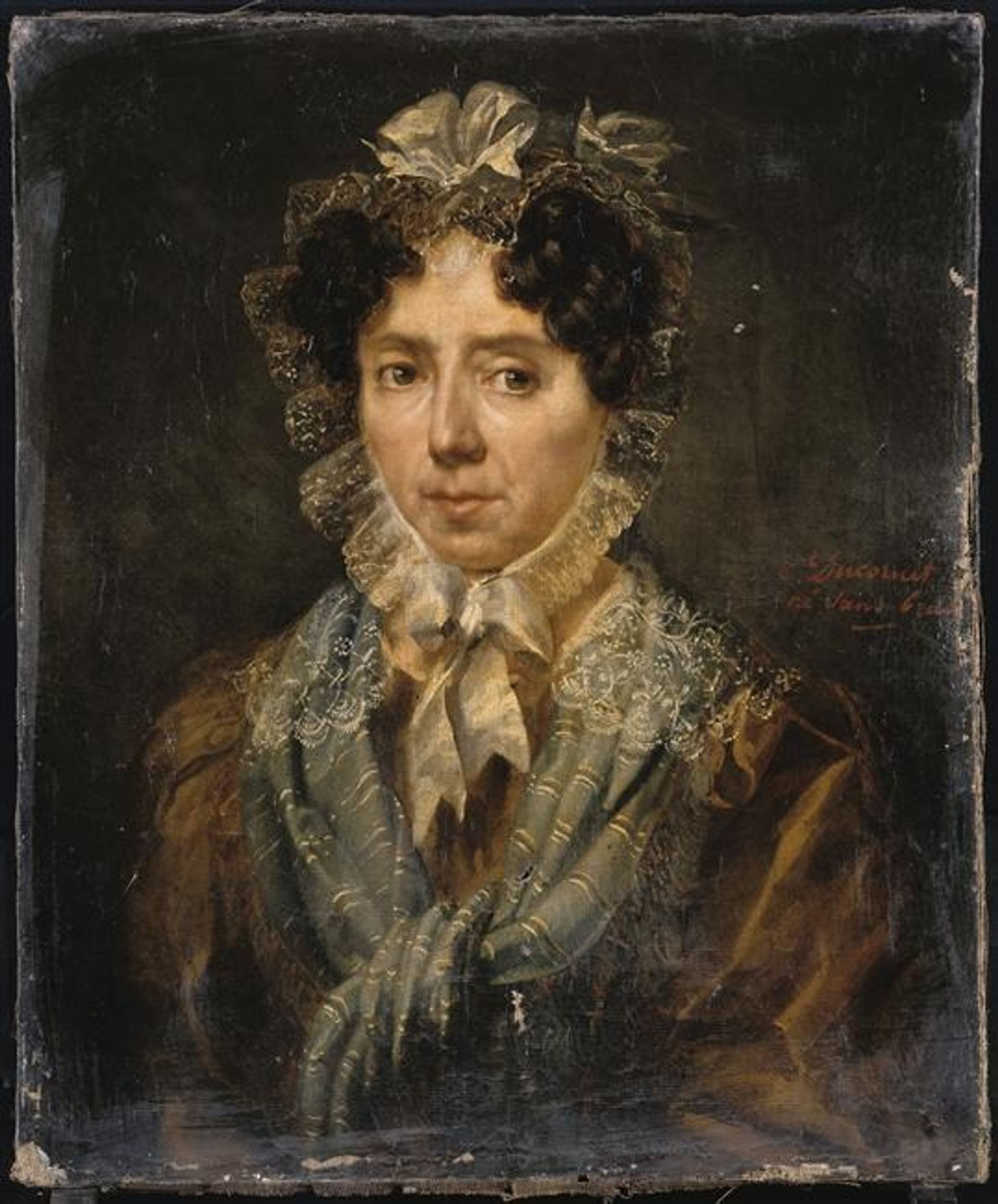
The rendering of the intricate lace collar reveals striking similarities to techniques associated with Ducoret's workshop practices. Due to his physical limitations, Ducoret developed an economical method for depicting delicate textile textures, bypassing the time-intensive process of colour layering by applying quasi-transparent white pigments directly over existing skin tones and fabric colours to suggest lace patterns. This distinctive brushwork approach appears frequently throughout Ducoret’s oeuvre, most notably in his portrait of his own mother, which features remarkably similar bourgeois attire and technical execution. The subject's gentle gaze, perfectly oval facial structure, subtle illumination, and deliberately neutral background collectively emphasise the figure while evoking an aspirational sense of timelessness—a quality highly valued in formal portraiture of this era. Despite minor surface irregularities that speak to the work's age and history, the painting retains its full evocative power and continues to offer significant historical and decorative interest as a representative example of late 19th-century academic portraiture traditions. A similar quality of brushwork can also be seen in Ducornet’s portrait of his mother, now part of the permanent collection at the Palais des Beaux-Arts de Lille.
Ref. : Ottley, Henry; Bryan, Michael, eds. (1875). A Biographical And Critical Dictionary Of Recent And Living Painters And Engravers. Piccadilly: Chatto & Windus. p. 56. Retrieved 10 January 2024 – via Google Books.
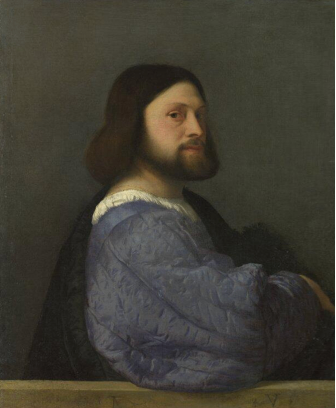
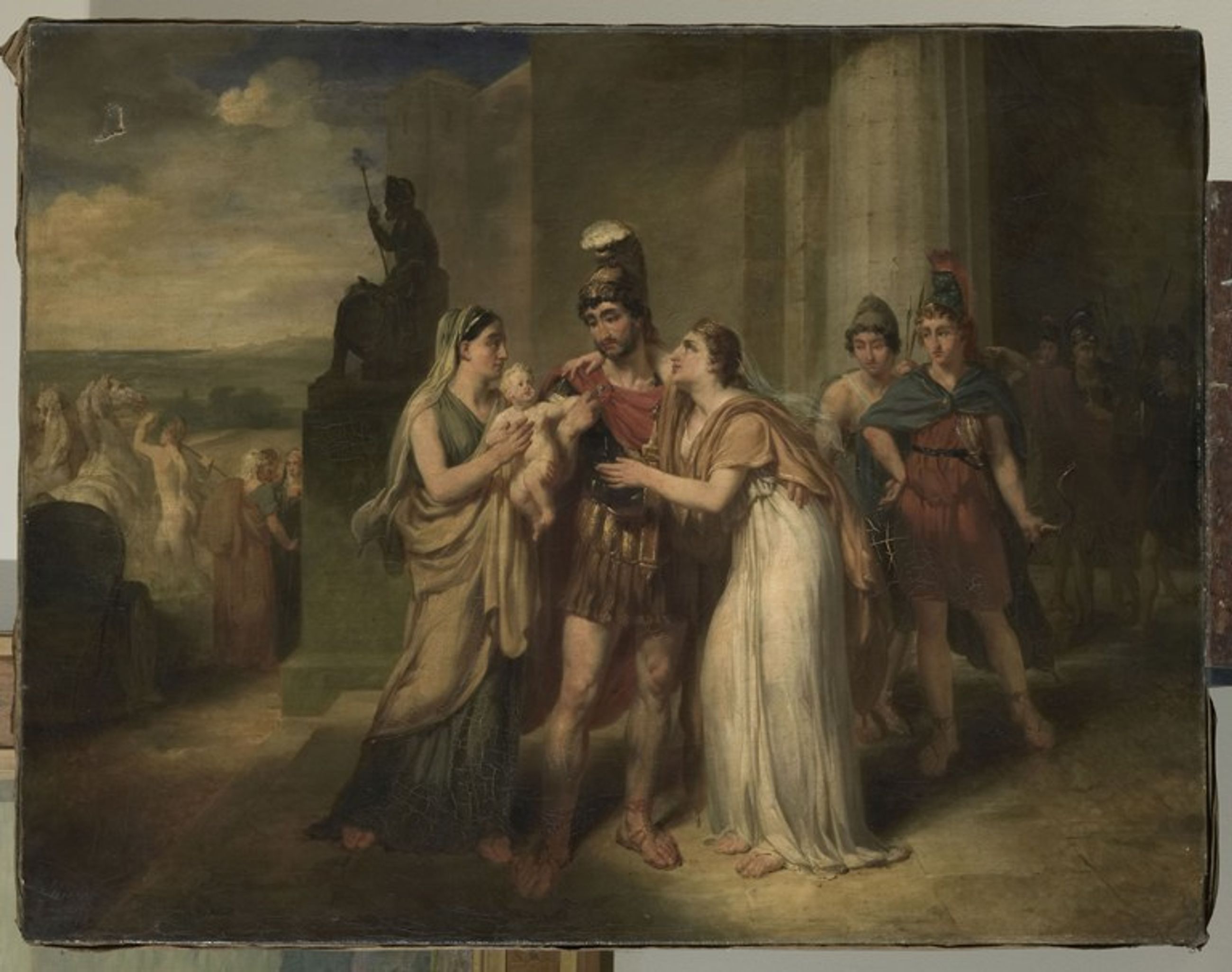
Louis Joseph César Ducornet was born with a congenital condition now recognised as phocomelia, which left him without arms or thighs and with only four toes on his right foot. Unable to walk independently, he relied on his father for mobility throughout his life. Despite his physical limitations, his artistic talent emerged remarkably early—as a young child, he would grasp pieces of coal with his toes and create rough sketches on walls. With financial support from the municipality of Lille, Ducornet travelled to Paris in 1824 to pursue formal training under distinguished masters, including Guillaume Guillon-Lethière, François Louis Joseph Watteau, and François Gérard. His talent earned royal recognition during the reign of King Louis XVIII, who granted him an annual pension of 1,200 francs—a stipend that King Charles X continued. Although his physical disability barred him from competing for the prestigious Prix de Rome, Ducornet's artistic achievements garnered widespread acclaim. He received multiple medals at the Paris Salon and secured commissions from the highest levels of French society, most notably from Emperor Napoleon III himself. As an established artist, he occasionally accepted students, with Auguste Allongé being among his most notable pupils. From 1845 until his death in 1856 at age 50, Ducornet maintained a studio on Rue Visconti in Paris. His artistic legacy endures through several masterworks housed in the permanent collection of the Palais des Beaux-Arts de Lille, including The Parting of Hector and Andromache and St. Louis Administering Justice (Fig. 3). The museum also preserves his death mask, as well as a sculptural replica of his feet, serving as a memorial to this remarkable artist who transcended extraordinary physical challenges to achieve lasting recognition in French academic painting.



 CN
CN